
Kospi Crashes More Than 7 Percent as Tech Selloff Deepens in Seoul
South Korea's benchmark index fell past 8 percent on Thursday, triggering 20 minute circuit breaker halts on both the Kospi and the Kosdaq as chip stocks sank and foreign investors sold.
Key points
- Taiwan has now closed, and the final count completes the Asia picture.
- Foreign institutions sold a net 302.56 billion Taiwan dollars of listed shares, and turnover reached 1.32 trillion Taiwan dollars, Taiwan News reported.
- London kept rising while tech shares fell.
Updated 17:51 UTC
Taiwan has now closed, and the final count completes the Asia picture. The Taiex closed at 46,969.87, down 1,655.96 points, or 3.41 percent, Focus Taiwan reported in coverage of the close. Electronics shares fell 3.84 percent. TSMC closed down 2.0 percent and MediaTek fell 6.9 percent.
Foreign institutions sold a net 302.56 billion Taiwan dollars of listed shares, and turnover reached 1.32 trillion Taiwan dollars, Taiwan News reported. The selling had the same root as Seoul. US inflation rose 3.7 percent in September, above the 3.6 percent forecast, and traders raised bets on tighter Federal Reserve policy while cutting debt heavy AI and chip shares. The Kospi close already reported here, 5,554.22, stands as the deepest fall in the region.
Updated 12:55 UTC
London kept rising while tech shares fell. The FTSE 100 was up 1.54 percent at 10,814.38 in early afternoon trade, from a previous close of 10,650.30. Reuters put the index at a near one month high, its highest since September 18, led by financial shares after Finance Minister John Healey said this month's budget would aim to build economic resilience and that he and Prime Minister Andy Burnham were aligned on keeping fiscal discipline. Stronger growth helped too. GDP rose 0.1 percent in August, against a forecast fall of 0.1 percent, and the yield on the 10 year gilt eased to 5.34 percent after Healey spoke.
Banks did much of the work. Reuters had NatWest up 2.3 percent and Standard Chartered up more than 1 percent in morning trade, and British American Tobacco rose 2.6 percent. Miners held the index back. Industrial metal miners fell 3.1 percent on weaker copper prices, and Antofagasta fell 5.8 percent after its third quarter copper output dropped from a year earlier. The Wall Street Journal noted early on that London carries little tech weight, with tobacco shares up even as miners fell. The split in the day's closes is now clear: Tokyo's Nikkei 225 closed down 4.9 percent at 64,425.95, reported above, while India's Sensex closed up 2.11 percent at 74,315.61.
Updated 11:55 UTC
The bond market has now flipped the other way. After the hot inflation report pushed the 10 year Treasury yield up to about 5.33 percent on Wednesday, buyers rushed back into Treasuries on Thursday in a flight to safety. Barron's put the 10 year yield at 5.077 percent early on Thursday, its lowest in three weeks, after a fall of 13 basis points into the Wednesday close and another 12 basis points in early trade. The Associated Press put it at 5.09 percent, and The Wall Street Journal said it had dropped below 5.10 percent, with the 30 year yield down 9.1 basis points to about 5.43 percent.
That move points the other way from inflation. Traders now look more worried that a sharp slowdown in AI building would drag on US growth than that prices will stay hot. Jefferies economist Mohit Kumar told Reuters a slowdown in the AI infrastructure build out would imply a sharp slowdown in US growth expectations. Credit markets showed the stress too. Barron's reported that high yield spreads widened to 324 basis points over Treasuries, matching the highest since March, and that the cost of insuring debt from names such as Oracle and CoreWeave hit new highs. The dollar gave ground as well. Barron's reported the DXY dollar index down 0.4 percent to 102.091 after an 18 month high on Wednesday, and the dollar also fell against the yen in trading reported by the AP.
Premarket falls deepened a little in the later snapshot. Barron's had CoreWeave down 5.6 percent, Micron down 4.4 percent and Nvidia down 1.7 percent before the bell, with Nasdaq futures down about 1.2 percent. New details on the finances of Anthropic, pointing to slower revenue growth, added to the selling, Barron's and Barchart reported. US producer price data and weekly jobless claims are due later on Thursday and are the next test.
Updated 08:42 UTC
The rout now points to another hard open in the United States. Reuters put Nasdaq 100 futures down 380.25 points, or 1.26 percent, at 04:04 a.m. Eastern on Thursday, with S and P 500 futures down 0.35 percent and Dow futures up 0.39 percent. Live market coverage in The Wall Street Journal also had Nasdaq 100 futures down more than 1 percent after the falls in Asia and Europe, and said Treasury yields eased as investors moved toward safer assets.
AI names fell again before the bell. CoreWeave, the data centre operator at the centre of the debt worry, fell 4.5 percent in premarket trade after a drop of about 15 percent on Wednesday, Reuters reported. Oracle fell 2 percent after losing close to 9 percent on Wednesday. Bonds of both firms came under pressure on Wednesday and their yields hit record highs. Chip shares also fell before the bell, with Nvidia down 1.3 percent, Micron down 4 percent and AMD down 1.9 percent.
TSMC added to the cautious tone. The world's largest maker of advanced chips reported a sixth straight record quarterly profit on Thursday, but said it was being careful in planning for 2027 because of wider economic uncertainty, Reuters reported. Investors now wait for US producer price data and other reports due later on Thursday for the next read on inflation.
Updated 07:52 UTC
The selloff has now reached Europe. Reuters reported the pan-European STOXX 600 index down 0.35 percent at 635.54 points by 07:09 GMT on Thursday, with the technology sector down 3.2 percent, as fears of higher borrowing costs hit the firms that rely on debt to fund AI infrastructure. The Wall Street Journal, reporting at 07:20 GMT, put the STOXX 600 down 0.5 percent in early trade and the semiconductor heavy Dutch AEX down 1.1 percent, as ASML fell 6.5 percent and ASM International fell 9.9 percent.
Chipmakers took the worst of it in Europe, just as they had in Seoul. In Germany, the DAX fell 0.5 percent, with Infineon down 8.7 percent and Siemens Energy down 6.6 percent, the Journal reported. STMicroelectronics fell 7 percent, while the CAC 40 in Paris was flat, helped by luxury shares, and London's FTSE 100 rose 0.2 percent, helped by tobacco shares. Ericsson was a rare bright spot, up 9.9 percent after a smaller than expected drop in third quarter core profit, Reuters reported. Attention now turns to the US open, with S and P 500 futures lower.
Updated 07:29 UTC
Seoul has closed, and the final numbers confirm the scale of the day. The Kospi closed at 5,554.22, down 454.59 points, or 7.57 percent, its lowest close since April, the Seoul Economic Daily reported, citing Korea Exchange figures. The Kosdaq closed at 760.82, down 63.06 points, or 7.65 percent.
Japan's Nikkei 225 closed down 4.9 percent at 64,425.95. In Seoul, Samsung Electronics closed down 9.48 percent and SK Hynix down 11.06 percent. Foreign investors were net sellers of 2.9 trillion won of main board shares, Reuters reported, and only 52 of 916 traded issues rose. South Korea's financial regulators held an emergency meeting during the afternoon, after which the fall narrowed a little from the intraday low.
The close makes seven straight losing sessions for the Kospi, its first such run since September 2024. Attention now turns to the US open, with futures lower after the Asia close.
Updated 06:21 UTC
Japan's Nikkei 225 deepened its fall to 5.05 percent, trading at 64,323.02 from a previous close of 67,744.29. Reuters and the Associated Press had earlier put the index down 4.8 percent at 64,489.06, with SoftBank Group down 9.4 percent, Tokyo Electron down 7.3 percent and Kioxia Holdings down 11.2 percent. Chip and AI shares led the drop after US consumer inflation rose 3.7 percent in September, up from 3.4 percent in August and above what economists had expected.
India moved the other way. The Sensex rose 1.58 percent to 73,928.87, from a previous close of 72,781.89. IT services shares led the gain. Tata Consultancy Services, Infosys and Tech Mahindra were among the top gainers in Mumbai, and reports put the Nifty IT index up more than 2 percent. The Hindu BusinessLine live blog and Upstox both reported an IT led rise in Mumbai despite the rout elsewhere in Asia. A firmer rupee, at 94.86 to the dollar, and Brent crude easing to about 104 dollars a barrel helped sentiment in India.
Updated 05:29 UTC
Trading in Seoul was halted for 20 minutes on Thursday after the selloff deepened past 8 percent and triggered first level circuit breakers on both the Kospi and the Kosdaq. The Korea Exchange activated the Kospi breaker at 12:38 p.m. local time, when the index stood at 5,528.05, down 480.76 points, or 8 percent, from the previous close. The Kosdaq breaker fired earlier, at 12:23 p.m., at 757.88, down 8.01 percent.
It was the first time since July 29 that breakers hit both boards on the same day. Reuters reported it was the Kospi's 10th circuit breaker this year and the 16th in its history, and that the index was heading for a seventh straight session of losses, its longest losing run since September 2024. Samsung Electronics fell 9.7 percent and SK Hynix lost 11.35 percent in the rout. After the 20 minute halt, trading was set to resume through a 10 minute single price auction. The market remains open, and this story will be updated with the closing numbers.
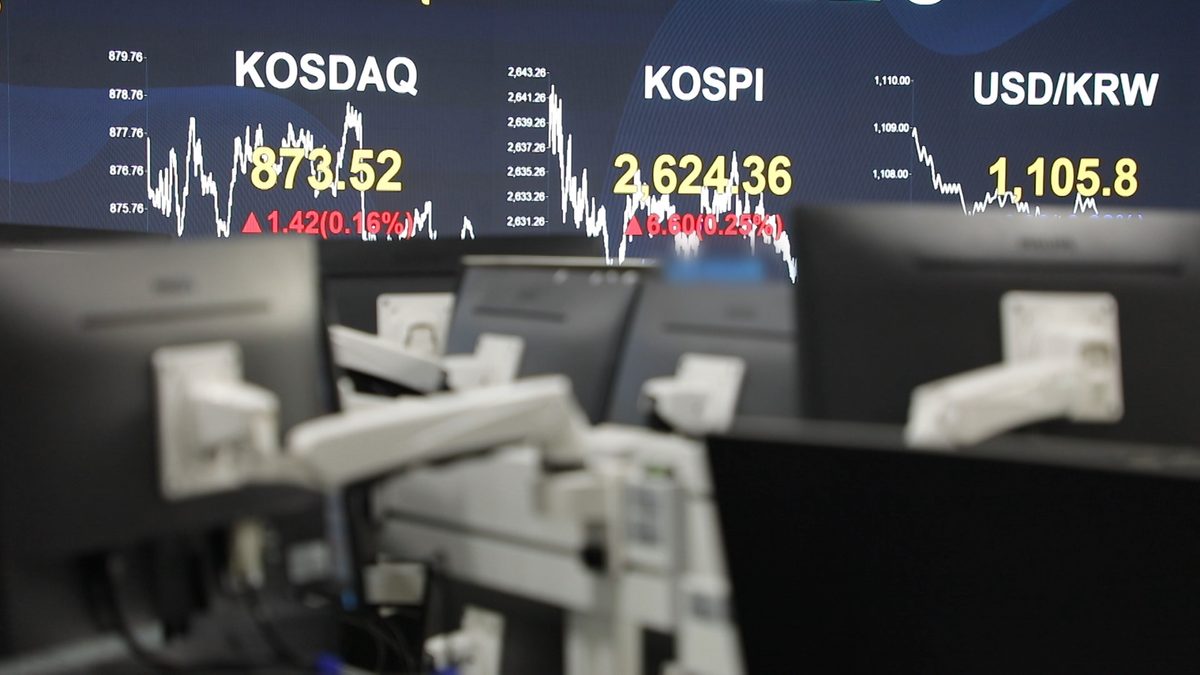
South Korea's benchmark Kospi index crashed more than 7 percent on Thursday as a global selloff in technology and chip shares deepened. The rout followed a hotter than expected US inflation print that hit Wall Street on Wednesday and revived talk of another Federal Reserve rate hike.
The Kospi fell 7.7 percent intraday to 5,548.78, with an intraday low of 5,534.24. By 11:20 a.m. in Seoul it traded near 5,605, down 6.75 percent. The Seoul market was still open at publication, and this story will be updated with the closing numbers.
Chip giants led the fall
Samsung Electronics fell about 9.5 percent. SK hynix plunged about 11.4 percent. The two chipmakers carry the biggest weight in the index, and their slide dragged the whole market down with them. Doubts about the payoff from huge AI spending, plus worries about chip supply from China, hit the sector across Asia.
Trading curbs kicked in
The Korea Exchange triggered sell-side sidecar curbs, which pause program selling, on the Kospi at 9:07 a.m. and on the Kosdaq at 9:12 a.m. It was the first time sell-side sidecars fired on both boards on the same day since July 29.
Foreign investors led the exit. They net sold between 1.9 and 2.45 trillion won of main board shares through the morning, depending on the snapshot, extending their selling streak to eight sessions.
The VKOSPI, the market's fear gauge, rose above 50 to 53.84 in mid-morning trade, more than double its long-term average.
The spark came from US inflation
US consumer prices rose 3.7 percent year on year in September, above the 3.6 percent forecast. Wall Street fell on Wednesday. The Nasdaq dropped 1.9 percent and the S and P 500 fell 1.1 percent. Rate hike fears punish the high valuations that AI and chip stocks carry, and Seoul took the hit first in Asia.
Asia fell with Seoul
Japan's Nikkei 225 fell 4.8 percent to 64,489.06. Taiwan's Taiex fell 3 percent. Hong Kong's Hang Seng fell about 1 percent, a slide covered in our Hang Seng flash earlier today.
Timeline
- Oct 14, 2026US September inflation printed at 3.7 percent year on year, hotter than the 3.6 percent forecast. Wall Street fell, with the Nasdaq down 1.9 percent and the S and P 500 down 1.1 percent.
- Oct 15, 2026Sell-side sidecar curbs triggered on the Kospi at 9:07 a.m. and on the Kosdaq at 9:12 a.m. in Seoul, the first same-day trigger on both boards since July 29.
- Oct 15, 2026The Kospi fell 7.7 percent intraday to 5,548.78 and traded near 5,605, down 6.75 percent, at 11:20 a.m. The VKOSPI fear gauge rose above 50.
- Oct 15, 2026First level circuit breakers triggered on the Kosdaq at 12:23 p.m. and on the Kospi at 12:38 p.m. in Seoul, halting trading for 20 minutes on both boards, the first same day trigger since July 29.
- Oct 15, 2026The Kospi closed at 5,554.22, down 7.57 percent, its lowest close since April. The Kosdaq closed down 7.65 percent at 760.82, and the Nikkei 225 closed down 4.9 percent at 64,425.95.
- Oct 15, 2026European markets opened lower as the selloff spread from Asia. Reuters put the STOXX 600 down 0.35 percent at 635.54 points by 07:09 GMT, with the technology sector down 3.2 percent, and the Wall Street Journal reported ASML down 6.5 percent and Infineon down 8.7 percent in early trade.
- Oct 15, 2026US Nasdaq 100 futures fell 1.26 percent in premarket trade at 04:04 a.m. Eastern, with CoreWeave down 4.5 percent and Oracle down 2 percent before the bell, as the AI debt selloff pointed to another lower open on Wall Street.
- Oct 15, 2026Treasury yields tumbled in a flight to safety, with the 10 year yield down to about 5.08 percent early on Thursday after touching about 5.33 percent on Wednesday, as traders weighed AI debt fears against hot inflation.
- Oct 15, 2026Taiwan's Taiex closed at 46,969.87, down 1,655.96 points, or 3.41 percent, with electronics shares down 3.84 percent and foreign institutions net sellers of 302.56 billion Taiwan dollars.
Sources
- Associated Press: South Korea's benchmark Kospi index sinks more than 7 percent as tech sell-off deepens
- Korea JoongAng Daily: Kospi plunges over 7 percent as AI doubts, US rate fears hit Seoul
- Associated Press via The Hindu BusinessLine: Sharp sell-off in tech stocks drags Asian stocks lower as markets in South Korea, Japan sink
- Reuters: South Korea's KOSPI triggers circuit breaker in tech-led selloff
- Korea JoongAng Daily: Kospi and Kosdaq trading halted after 8% stock market plunge
- Seoul Economic Daily: Korea Halts Trading as KOSPI, KOSDAQ Plunge 8% on Rate, AI Fears
- Reuters: Asian stocks sell off as AI trades crumble after hot US inflation data
- The Hindu BusinessLine: Sensex, Nifty, Share Prices Live, October 15, 2026
- Upstox: Sensex surges, Nifty 50 led by gains in IT shares
- Seoul Economic Daily: KOSPI plunges 7.6% to six-month low in 'Black Thursday' selloff
- Reuters via The Hindu BusinessLine: South Korea's KOSPI triggers circuit breaker in tech-led selloff
- Reuters: European shares fall as global tech rout hits risk appetite
- The Wall Street Journal: European Indexes Mixed as AI Selloff Deepens
- Reuters: Nasdaq futures dive 1% as AI rout deepens on debt concerns
- The Wall Street Journal: Stock market today live coverage, October 15, 2026
- Barron's: The AI Selloff Is Bad but the Bond Market's Reaction Is Worse
- Barron's: Treasury Yields Tumble as AI Concerns Offset Faster Inflation Data
- The Wall Street Journal: Nasdaq Futures Slide as Global AI Selloff Gathers Pace
- Associated Press: A tech sell-off drags stocks lower as markets in South Korea and Japan sink
- Barchart: Nasdaq Futures Plunge as AI Rout Rolls On; U.S. PPI Data and Warsh's Remarks in Focus
- Reuters: UK's FTSE 100 hits near one-month high after Healey backs fiscal discipline
- Focus Taiwan via Ad Hoc News: Taiwan Weighted (TAIEX) closes 3.4 percent lower after CPI
- Yonhap Infomax: Asian stock markets summary, Taiwan Weighted closes at 46,969.87