
Israel Election Tuesday: Netanyahu vs Eisenkot, What to Know
Polls open at 7 a.m. and close at 10 p.m. on Tuesday for the 120 seat Knesset. A government needs 61 seats, final polls put Eisenkot's Yashar just ahead of Netanyahu's Likud, and neither bloc is close to a majority on its own.
Key points
- Updated 10:30 UTC, Oct. 27, 2026.
- The final tally is expected by October 30, and official results are formally published on November 4.
- Israelis vote on Tuesday, October 27, 2026, for the 26th Knesset, the country's parliament.
Update: Voting is under way, polls close at 10 p.m.
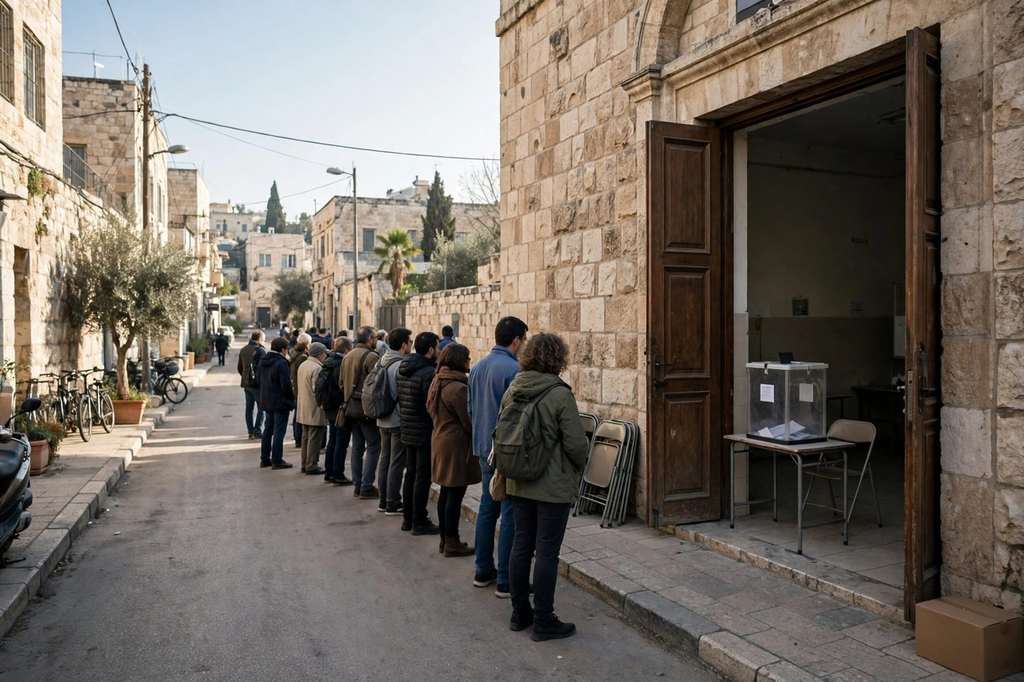
Updated 10:30 UTC, Oct. 27, 2026. Voting is under way across Israel in the election for the 26th Knesset, the first national vote since the Hamas attack of October 7, 2023. Polling stations opened at 7 a.m. and close at 10 p.m. Israel time, when television channels will publish exit polls, Reuters reported. Exit polls are not results. Counted ballots from polling stations are expected to start appearing in the early hours, with a clearer picture possible a few hours after polls close if one bloc has a clear path to 61 seats.
The final tally is expected by October 30, and official results are formally published on November 4. After that, President Isaac Herzog will consult party leaders and give one candidate the task of forming a government. That candidate has up to 42 days to build a coalition. About a dozen parties have a chance of clearing the 3.25 percent threshold, so small party results will decide who can reach 61 seats in the 120 seat Knesset.
Israelis vote on Tuesday, October 27, 2026, for the 26th Knesset, the country's parliament. It is the first general election since the Hamas attack of October 7, 2023 and the wars that followed in Gaza, Lebanon and Iran. Prime Minister Benjamin Netanyahu, in office for 19 years across his terms and the longest serving leader in Israel's history, is seeking another term while standing trial on corruption charges. The challenger leading the opposition side is Gadi Eisenkot, a former military chief of staff whose party is called Yashar.
How the vote works
About 7.3 million people aged 18 and above are eligible to vote, according to Israel's Central Elections Committee. Most polling stations open at 7 a.m. and close at 10 p.m., and anyone still in line at closing time can vote. Election day is a national holiday. Voters choose a party list, not a person. The Knesset has 120 seats and a government needs 61. No party has ever won 61 seats on its own, so every Israeli government is a coalition. A list needs 3.25 percent of the valid vote to enter parliament at all. Thirty eight lists qualified for this election. After the vote, parties have 28 days to build a coalition, with a possible extension of up to 14 days. If no one reaches 61, the country votes again.
What the final polls say
Final polls published on October 23 put Yashar at 22 to 23 seats and Netanyahu's Likud at 19 to 21 seats. Poll averages show neither the Netanyahu bloc nor the opposition bloc near 61 seats on its own, with the opposition at about 52 to 56 seats and the Netanyahu bloc at about 50. The other lists include Together, led by Naftali Bennett and Yair Lapid, the Democrats, Yisrael Beytenu, Shas, United Torah Judaism, Religious Zionism-Zehut, Otzma Yehudit, the Joint List and Ra'am. President Donald Trump has endorsed Netanyahu, as Orbit Post reported this week. Israeli polls have a record of missing the final result, so the numbers are a guide to the race, not a forecast.
The issues and what happens next
The campaign has turned on whether there should be a state inquiry into October 7, the conscription of ultra Orthodox men, judicial reform, the cost of living and security in the West Bank, Gaza and toward Iran. Orbit Post reported on October 25 that all West Bank land crossings will close on election day and Palestinian workers are barred from settlements from Sunday. Preliminary results are expected the day after the vote, and official results are expected around November 4. The count on Tuesday night is only the first step. The coalition talks that follow will decide who governs, and they can run for weeks.
Timeline
- Oct 23, 2026Final polls put Yashar at 22 to 23 seats and Likud at 19 to 21 seats, with neither bloc near the 61 seats needed for a majority.
- Oct 25, 2026Israel bars Palestinian workers from West Bank settlements, ahead of closing all West Bank land crossings on election day.
- Oct 27, 2026Israel votes for the 26th Knesset. Most polling stations open at 7 a.m. and close at 10 p.m.
- Nov 4, 2026Official election results are expected around this date, while coalition talks run on a 28 day clock with a possible 14 day extension.
- Oct 30, 2026The final tally is expected by this date. Official results are formally published on November 4, after which President Isaac Herzog consults party leaders on forming a government.
Sources
- Al Jazeera via Bahamas Spectator: Israel's elections 2026 explained in maps and charts
- AIJAC: Fact sheet, the 2026 Israeli election
- Israel Gazette: Israel election 2026 guide, parties, polls, how to vote
- Reuters: Israel's election will be held on October 27, coalition head says
- Reuters: Israel election, what happens after polls close
- Reuters: Live 2026 Israel election results