
Iran Sets Supertanker Ablaze Hours After US Blockade Strike
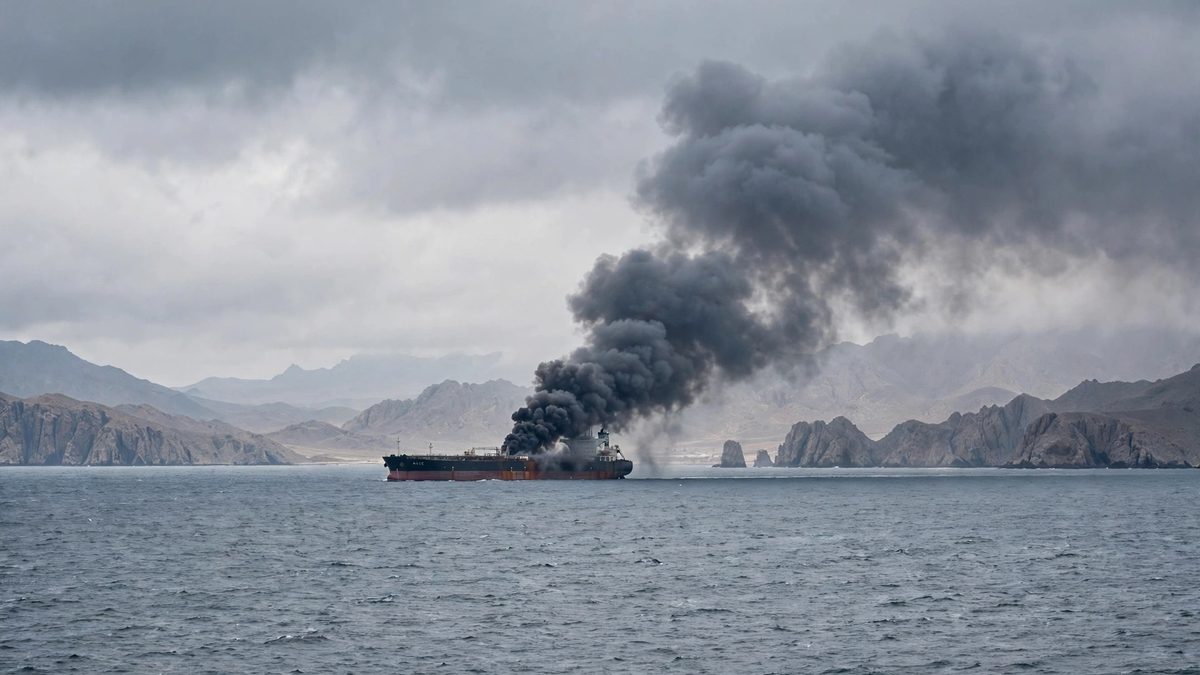
A supertanker caught fire in the Strait of Hormuz on Sunday after a projectile strike, hours after a US fighter jet disabled a ship trying to run the blockade. Iran claims the tanker hit one of its mines.
Key points
- An oil supertanker burst into flames in the Strait of Hormuz on Sunday, Oct. 11, struck on its port side by an unknown projectile as it sailed one of the world's most important oil shipping lanes.
- The strike came hours after the United States moved on Saturday, Oct. 10, against a ship trying to run its naval blockade of Iran.
- Within hours, Iran claimed the burning tanker as its own work.
An oil supertanker burst into flames in the Strait of Hormuz on Sunday, Oct. 11, struck on its port side by an unknown projectile as it sailed one of the world's most important oil shipping lanes. The fire spread across the vessel. The crew survived and stayed aboard.
The strike came hours after the United States moved on Saturday, Oct. 10, against a ship trying to run its naval blockade of Iran. A US fighter jet hit the stern of the Panama-flagged M/V Ocean Molica, also called the Arika Sun, with a precision munition in the Gulf of Oman, disabling its propulsion. US Central Command said the ship had ignored repeated warnings and had sailed from an Iranian port. No crew members were hurt.
Within hours, Iran claimed the burning tanker as its own work. The Islamic Revolutionary Guard Corps said the vessel struck one of its naval mines and exploded. The IRGC released video of the ship ablaze and warned that 'a devastating fire is the fate of any tanker that violates the rules and disregards security in the Strait of Hormuz.'
That account is not confirmed. The British monitor that logged the attack, UK Maritime Trade Operations, reported a projectile strike, not a mine, and said the incident is under investigation. The tanker was not named, and no independent evidence has shown the ship Iran described is the same one UKMTO logged.
Sunday's fire was the second logged strike in two days. On Saturday, the master of another outbound tanker reported being hit on the port side by an unknown projectile. The UAE National Guard said it rescued 22 people, all Indian citizens, after an oil tanker fire on Saturday.
Why it matters
Oil is already trading above $100 a barrel, and the Strait of Hormuz is the chokepoint for a large share of the world's seaborne oil. Every strike raises the risk premium on tankers that pass through, and that cost lands on fuel prices, freight bills, and anything shipped by sea. The International Maritime Organization counted at least 11 tankers attacked in the week ending Oct. 4, the most strikes on commercial ships in the strait since the war began on Feb. 28, with roughly 10 more the following week.
For ordinary households, the math is direct. More risk in the strait means higher shipping insurance, and higher shipping costs show up at the pump and on store shelves. Iran is betting that pain pushes Washington toward a deal. Washington is betting the blockade starves Iran's oil income first.
The context
The tanker war has run nearly every day this month, according to the IMO. On Oct. 5, an attack injured 12 Indian sailors aboard the UAE-owned tanker On Peace. On Friday, the IRGC said its forces hit the giant liquefied petroleum gas carrier NV Sunshine on a southern route, setting its engine room on fire. That claim, like Sunday's, comes only from Iran.
The US blockade is the other half of the fight. Since it resumed on July 14, American forces have disabled four vessels and turned around 135 ships, according to Central Command, and destroyed 10 tankers it links to the IRGC's shadow oil network. Iran says the strait is closed to Israeli and US-affiliated ships and demands that vessels keep their navigation systems on and sail approved routes. On Sunday, the IRGC warned that ships sailing with their systems switched off will be treated as hostile and 'dealt with firmly and decisively.'
The Orbit Post covered the earlier wave of attacks on Oct. 9, when Brent crude surged to $104.
Key numbers
- At least 11 tankers attacked in the week ending Oct. 4, the most since the war began Feb. 28, per the IMO
- Roughly 10 more strikes the following week, including the Oct. 5 attack that injured 12 Indian sailors aboard the On Peace
- 4 vessels disabled and 135 ships turned around since the US blockade resumed July 14, per US Central Command
- 10 tankers destroyed that the US links to the IRGC's shadow oil network
- Oil trading above $100 a barrel
- 22 people, all Indian citizens, rescued by the UAE National Guard after Saturday's tanker fire
What happens next
Diplomacy is running on a separate clock. President Trump said last week that talks with Iran have been productive and that he will not strike the regime before the Nov. 3 midterm elections. Iran's president, Masoud Pezeshkian, said Iran will not abandon the negotiating table even as the fighting goes on.
That leaves the strait as the pressure point. Watch three things this week: whether oil holds above $100 or climbs on Monday trading, whether UKMTO logs more strikes, and whether Washington answers Iran's mine claims directly or sticks to blockade enforcement. Every burned tanker makes the negotiating table harder to reach.
This is a developing story. The Orbit Post will update this article as the investigation continues.
Timeline
- Feb. 28, 2026The war involving the US, Israel, and Iran begins; Iran bars Israeli and US-affiliated vessels from safe passage in the Strait of Hormuz.
- Oct. 4, 2026The IMO counts at least 11 tankers attacked in the week ending this day, the heaviest week of strikes on commercial ships since the war began.
- Oct. 5, 2026An attack injures 12 Indian sailors aboard the UAE-owned tanker On Peace.
- Oct. 9, 2026The IRGC says its forces hit the LPG carrier NV Sunshine on a southern route, setting its engine room on fire.
- Oct. 10, 2026A US fighter jet disables the Panama-flagged Ocean Molica, also called the Arika Sun, in the Gulf of Oman after it ignores blockade warnings; UKMTO logs a projectile strike on an outbound tanker in the strait.
- Oct. 11, 2026UKMTO reports a second outbound tanker struck on the port side by an unknown projectile; the crew survives. The IRGC claims the tanker hit one of its mines, releases video, and warns that tankers crossing without permission face fire.
Sources
- New York Post: Iran sets supertanker ablaze after US takes out ship breaking blockade
- Reuters: Tanker struck by projectile in Strait of Hormuz, fire reported, UKMTO says
- Unbiased Headlines: Iran claims supertanker hit mine in Hormuz as UKMTO logs tanker strikes on two straight days
- Ghanamma: US military disables ship attempting to bypass Strait of Hormuz blockade