
Hummingbirds Are the Only Birds That Can Fly Backwards
A hummingbird can hang still in the air, fly backwards, and even fly upside down. No other bird can do all three, and the secret sits in one rotating shoulder joint.
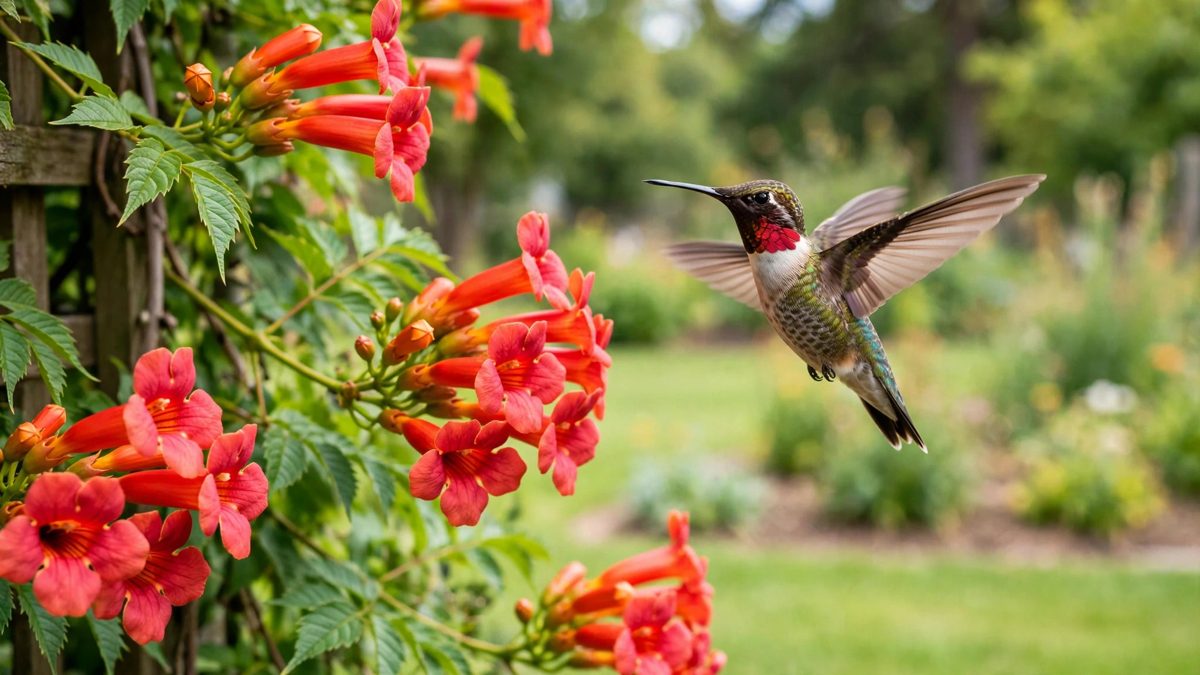
Key points
- Hummingbirds are the only birds that can fly backwards on purpose, for as long as they want.
- Most birds get lift on only half of each wingbeat.
- The whole bird weighs between 2 and 20 grams, according to the Smithsonian's National Zoo.
Hummingbirds are the only birds that can fly backwards on purpose, for as long as they want. They can also hang completely still in midair, rise straight up, drop straight down, and flip upside down. The Smithsonian's National Zoo calls them the only vertebrates capable of sustained hovering, meaning they can hold one spot in the air without drifting.
Most birds get lift on only half of each wingbeat. The wing pushes down and makes lift, then folds a little and comes back up with as little drag as the bird can manage. A hummingbird works both halves. Its wing stays almost rigid and pivots at the shoulder, flipping over on the backstroke so it makes lift on the way back as well as on the way down. The wingtips trace a figure eight in the air. Tilt that figure eight one way and the bird hovers. Tilt it another way and the bird slides backwards, sideways, or straight up.
Built like a helicopter, sized like a coin
The whole bird weighs between 2 and 20 grams, according to the Smithsonian's National Zoo. A ruby-throated hummingbird weighs less than a nickel. The wings beat up to 80 times a second in some species, fast enough that the sound blurs into the hum that gives the bird its name. Smithsonian Gardens notes that hummingbirds spend up to 90 percent of their flying time hovering, because hovering is how they eat. They hold still in front of a flower, push a long bill inside, and drink nectar without landing on anything.
Backwards flight solves a simple problem. A bird parked in front of a deep flower needs a clean way out. It cannot turn around inside the flower, and it has no perch to push off from. So it reverses. Cornell Lab of Ornithology researchers describe the same trick in plainer terms: hummingbirds keep their wings rigid, rotate them at the shoulder, and produce lift on the upstroke as well as the downstroke, more like an insect than like other birds. That is why their flight looks so different. Other birds flap. Hummingbirds scull the air.
Speed is part of the package
These are not slow, delicate fliers. The National Zoo reports hummingbirds clocked at close to 30 miles per hour in direct flight and more than 45 miles per hour during courtship dives. There are more than 360 hummingbird species, and every one of them lives in the Americas, from Alaska down to the tip of South America, with the greatest variety in the tropical Andes.
So the next time one hangs in front of a feeder, watch how it leaves. It will not swing wide and turn like a sparrow. It will simply back away in a straight line, stop, and pick a new angle. That small reverse gear, powered by a shoulder that can rotate the wing through a half circle, is something evolution built for birds exactly once.