
Scorpions Glow Blue Green Under Ultraviolet Light, and Nobody Knows Why
Under ultraviolet light, a plain brown scorpion turns blue green. The glow lives in one thin layer of its shell, it even survives in fossils, and scientists still do not know what it is for.
Key points
- Shine an ultraviolet light on a scorpion in the dark and the plain brown animal turns blue green.
- The Queensland Museum traces the glow to one thin part of the shell.
- A fresh scorpion does not glow.
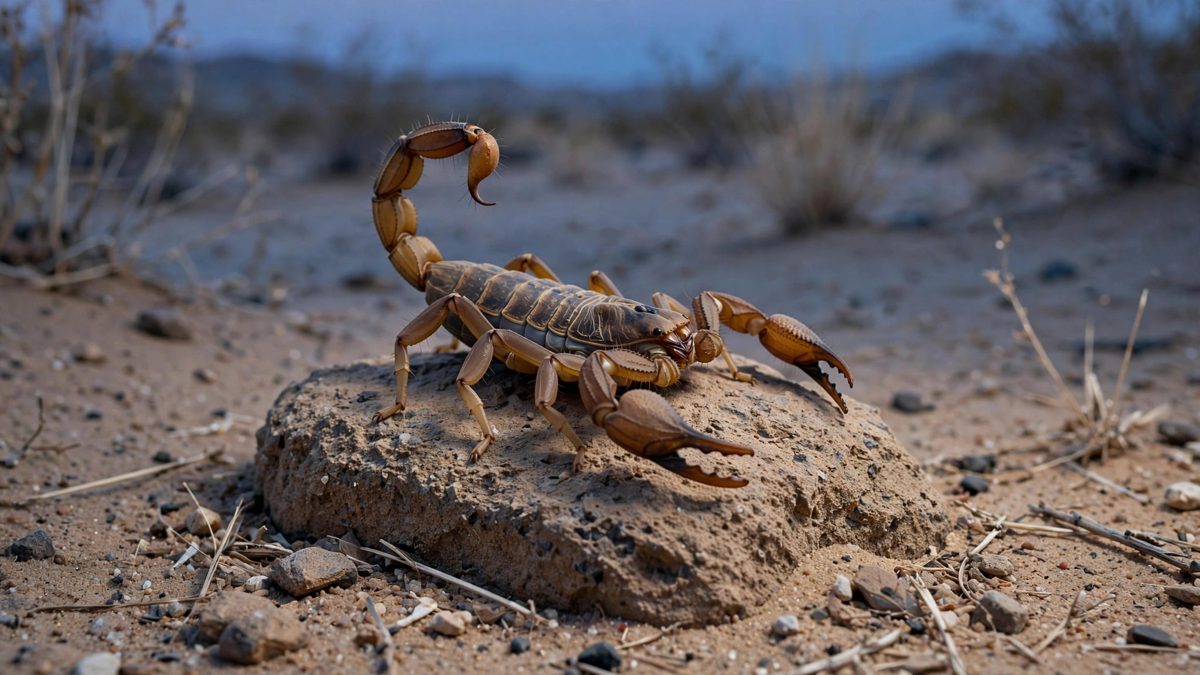
Shine an ultraviolet light on a scorpion in the dark and the plain brown animal turns blue green. It is not a trick of the lamp and it is not the scorpion making its own light. The shell does it. Chemicals in the outer cuticle absorb ultraviolet light that human eyes cannot see and give it back as visible blue green light, a process called fluorescence. Turn the lamp off and the glow stops at once.
The Queensland Museum traces the glow to one thin part of the shell. A substance in a very thin layer of the cuticle, called the hyaline layer, produces the effect when ultraviolet light hits it. University of Maryland researchers name two of the compounds involved, beta-carboline and a coumarin called 4-methyl-7-hydroxycoumarin, both held in that outer layer. The layer is tough. It survives so well that even fossil scorpions can still fluoresce, the Queensland Museum notes, and preserved specimens can make the liquid in their jars glow.
A glow the animal has to grow into
A fresh scorpion does not glow. Newly moulted and young scorpions show no fluorescence until the new exoskeleton hardens, according to the Queensland Museum. The glow arrives as the shell sets over the following days. That detail is a useful clue. The fluorescent compounds appear to be part of how the cuticle is built or finished, not a signal the animal switches on and off at will.
The effect is so reliable that it changed how people study these animals. A 2005 paper in The Journal of Arachnology notes that the fluorescence of the scorpion exoskeleton under long wave ultraviolet light was long used for the capture and observation of scorpions at night, before researchers began using it to image fine detail on the shell itself. A person walking desert or forest floor at night with a UV lamp can spot a scorpion many steps away, lit up against dark ground that hides it completely in daylight.
Why it glows is still an open question
Here is the honest part. Nobody knows for certain what the glow is for. The Queensland Museum lays out the leading ideas and the doubt that comes with them. One idea is that the whole shell works as a light sensor. If the cuticle converts ultraviolet into light the scorpion can register, the animal could judge how exposed it is under moonlight and starlight, and find shade or shelter when too much of its body is lit. Parts of the body passing into shadow would change the signal, which could help a night hunter stay hidden.
The rival idea is simpler and harder to rule out. The glow may do nothing at all. Some arachnologists argue it is a side effect of the chemistry that makes the cuticle hard and durable, an accident of how the shell is built rather than a tool the animal uses. Both ideas fit the known facts, and the evidence has not settled between them.
What is settled is the glow itself. It sits in nearly every scorpion a UV lamp has ever tested, it has lasted in shells for far longer than humans have existed, and it turns one of the best hidden animals on Earth into one of the easiest to find, as long as you bring the right light.