
In 1932 Australia Sent Machine Guns Against 20,000 Emus. The Emus Won.
Soldiers with two Lewis machine guns and 10,000 rounds spent five weeks fighting flightless birds in the Western Australian wheat belt. The official count at the end was 986 emus, and the army went home.
Key points
- In November 1932, the Australian army opened fire on birds, and the birds won.
- The farmers were mostly former soldiers.
- The force was tiny.
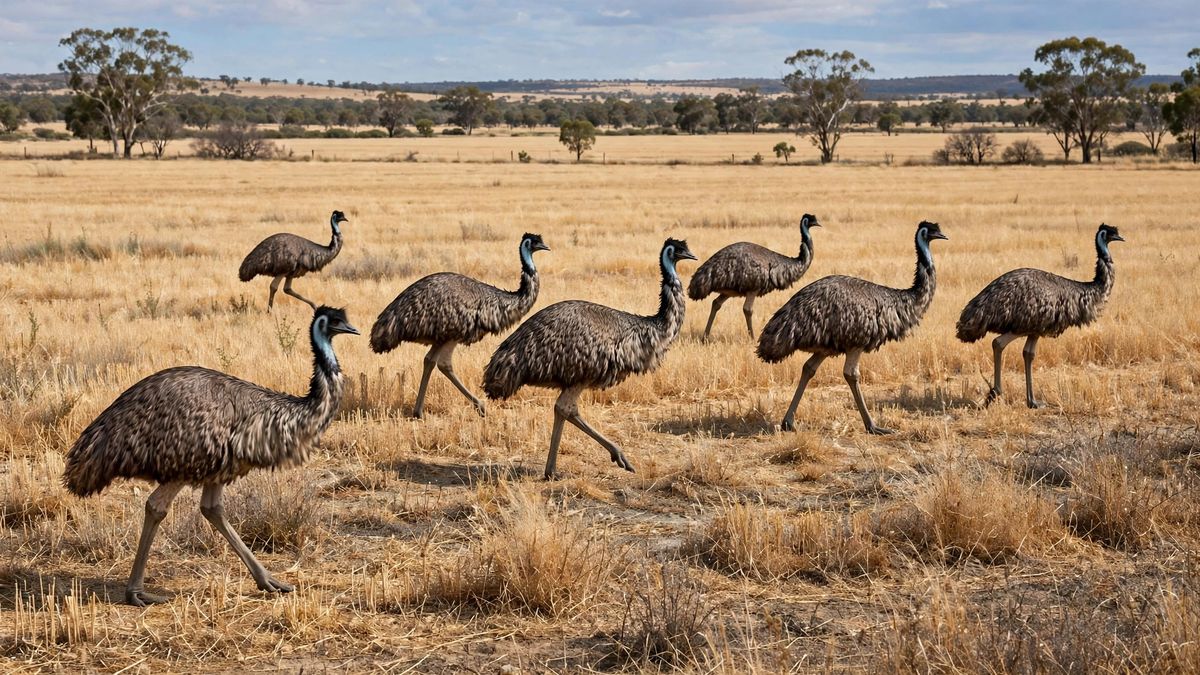
In November 1932, the Australian army opened fire on birds, and the birds won. About 20,000 emus had marched into the wheat country around Campion in Western Australia, eating crops and trampling fences. The government sent soldiers with machine guns to stop them. Five weeks later the soldiers left, and the emus were still there.
The farmers were mostly former soldiers. After the First World War, Australia had settled returned servicemen on hard, dry land in the west and told them to grow wheat. The land was marginal, the prices were poor, and then the emus arrived in their usual post-breeding migration, in numbers the district could not absorb. The birds ate the wheat and knocked holes in fences, which let rabbits in behind them. The settlers asked the Minister of Defence, Sir George Pearce, for machine guns. Pearce agreed to send the army instead, with conditions: the farmers would feed and house the troops and pay for the ammunition.
Two guns against 20,000 birds
The force was tiny. Major G. P. W. Meredith of the Royal Australian Artillery arrived with Sergeant S. McMurray and Gunner J. O'Halloran, two Lewis machine guns and 10,000 rounds. The first shots were fired on November 2, 1932. On November 4, the men ambushed about 1,000 emus coming to drink at a dam. The gun jammed after about a dozen birds fell, and the flock scattered. That pattern held for the whole campaign. Emus under fire did not bunch together like targets. They split into small groups and ran in every direction, at speeds a truck on rough ground could not match. A gun mounted on a truck could not be aimed as the vehicle bounced, and the attempt failed as well.
By November 8, the men had spent about 2,500 rounds for a return the reports put somewhere between 50 and a few hundred birds. Politicians suspended the operation while arguments ran over who was paying for it. The settlers demanded the army back, and the campaign resumed on November 12. It ran until Meredith was recalled on December 10. His final report claimed 986 emus killed with 9,860 rounds, almost exactly ten rounds per bird, a tidiness historians have doubted ever since.
The fence did what the guns could not
The army never went back to fight emus. Later requests for military help were refused, and the work of keeping emus off wheat land fell to the tool that actually functioned: long barrier fencing, extended over the following years, backed by bounties paid to farmers. The 1932 campaign survives in the archives of the time and in a peer-reviewed account in the Journal of Australian Studies, which is why historians treat it as a real, if absurd, operation rather than a tall tale. An army with modern weapons lost to birds that cannot fly, because the birds' whole defence was to scatter faster than anyone could aim.