
Your Head Is Older Than Your Feet. Atomic Clocks Proved It.
NIST raised one atomic clock by just 33 centimetres and it ran faster. Over a 79 year lifetime the gap adds up to about 90 billionths of a second.
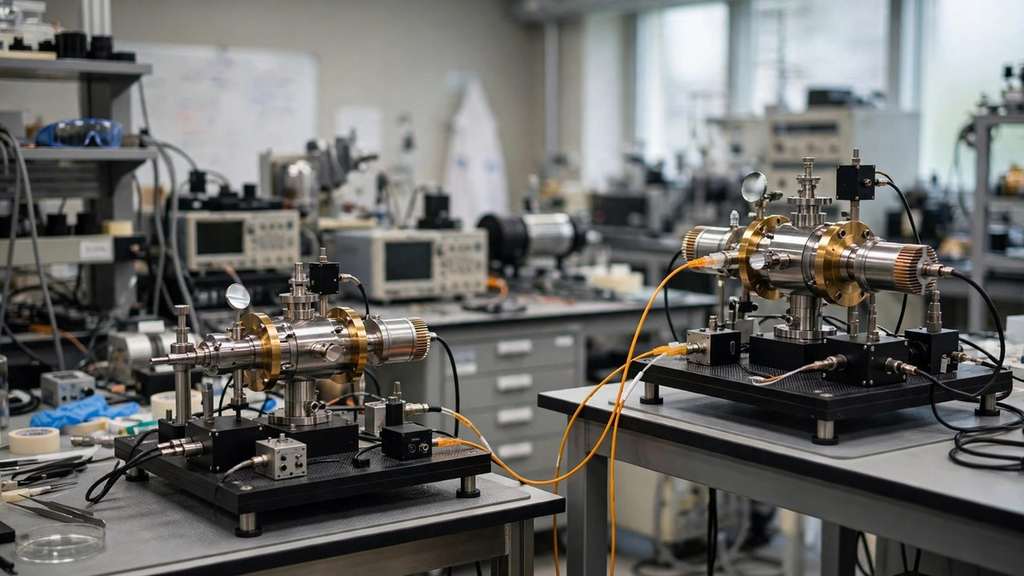
Key points
- Your head is older than your feet.
- Physicists at the National Institute of Standards and Technology, known as NIST, proved the point in 2010 with a pair of experimental atomic clocks.
- The team linked the two clocks with a 75 metre optical fibre, then raised one clock by just 33 centimetres, about one foot, on its laser table.
Your head is older than your feet. That is not a riddle. It is a measured fact, and the gap grows by a tiny amount every day you spend standing up.
Physicists at the National Institute of Standards and Technology, known as NIST, proved the point in 2010 with a pair of experimental atomic clocks. Each clock ticked by tracking a single aluminium ion vibrating between two energy levels a million billion times a second. One of those clocks keeps time to within one second in about 3.7 billion years, precise enough to notice effects no human sense could ever catch.
One foot of height was enough
The team linked the two clocks with a 75 metre optical fibre, then raised one clock by just 33 centimetres, about one foot, on its laser table. The higher clock ran faster. It sat a fraction farther from the centre of the Earth, felt a slightly weaker pull of gravity, and time moved a little quicker for it, exactly as Albert Einstein's general theory of relativity predicts.
The size of the effect explains why nobody feels it. NIST calculated that the difference adds up to about 90 billionths of a second over a 79 year lifetime. Your head ages faster than your feet, but by less than the time it takes light to cross a room. The result was published in the journal Science on September 24, 2010, and it was the first time this part of relativity had been measured at the scale of a staircase instead of a rocket.
Moving clocks run slow, too
The same clocks caught the second half of Einstein's prediction. When the researchers set the ion in one clock moving back and forth at speeds of a few metres a second, similar to a car travelling at about 20 miles per hour, that clock ticked more slowly than its still partner. Motion slows time. Height speeds it up. Both effects are real at everyday scales, even if both are far too small to change a human life.
Later work pushed the measurement even finer. In 2022, physicists at JILA, a joint institute of NIST and the University of Colorado Boulder, compared clocks separated by a single millimetre inside a cloud of about 100,000 ultracold strontium atoms. The top of the cloud ticked at a different rate from the bottom. Their results, published in Nature in February 2022, suggested routes to clocks 50 times more precise than the best current designs.
Why a tiny effect matters
Relativity at this scale is not a parlour trick. GPS satellites sit high above the Earth, where time runs faster, while also moving fast, which slows it. Engineers must correct for both effects or the positions the system reports would drift badly. Clocks that can feel a millimetre of height may one day map the shape of the Earth itself by measuring gravity directly.
So the next time you climb a flight of stairs, the physics is settled. The person at the top is, by an almost impossibly small margin, ageing faster than the person at the bottom. Einstein said time was personal. NIST showed it is personal within a single body.