
Trump Lawyers Ask New York Appeals Court to Throw Out Hush Money Conviction
A five judge panel in Manhattan hears arguments on Thursday on whether the 34 count felony verdict from May 2024, the first criminal conviction of a former president, should stand.
Key points
- President Donald Trump's lawyers go before a New York appeals court on Thursday to ask that his hush money conviction be thrown out, two years after a Manhattan jury made him the first former…
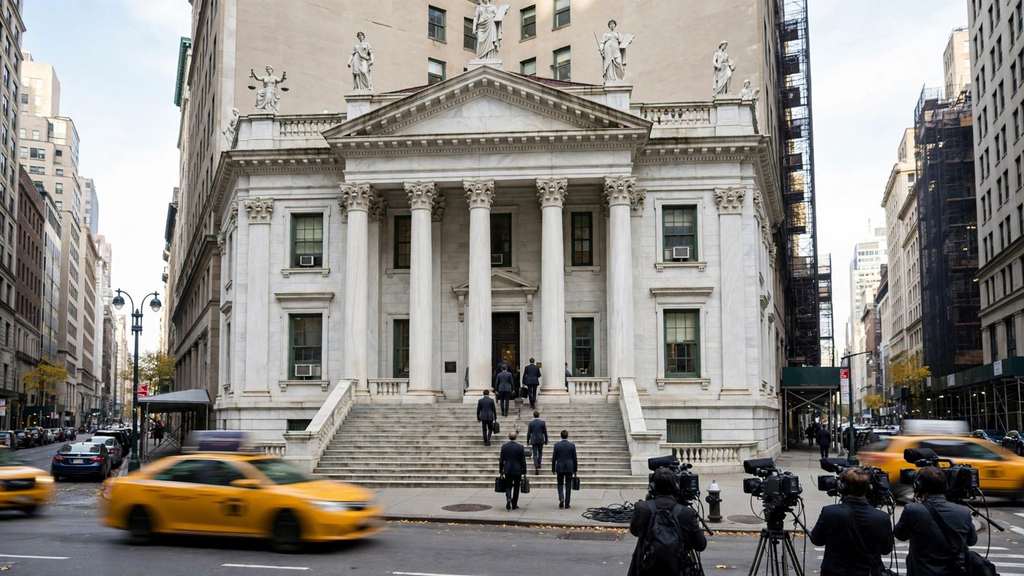
- The hearing is before a five judge panel of the Appellate Division, First Department, the state's mid level appeals court in Manhattan.
- A jury convicted Trump in May 2024 on 34 felony counts of falsifying business records.
President Donald Trump's lawyers go before a New York appeals court on Thursday to ask that his hush money conviction be thrown out, two years after a Manhattan jury made him the first former president in American history to be convicted of a crime.
The hearing is before a five judge panel of the Appellate Division, First Department, the state's mid level appeals court in Manhattan. Lawyers for Trump and for Manhattan District Attorney Alvin Bragg each get 15 minutes to answer the judges' questions, CBS News reported. Trump is not expected to attend. He needs a majority of the five judges to win.
What the jury decided
A jury convicted Trump in May 2024 on 34 felony counts of falsifying business records. Prosecutors said the records hid a $130,000 payment that his lawyer at the time, Michael Cohen, made to adult film performer Stormy Daniels weeks before the 2016 election. The money bought her silence, for a time, about an alleged sexual encounter with Trump a decade earlier. Trump says nothing sexual happened between them.
Trump's company reimbursed Cohen in 2017 and logged the payments as legal expenses. Prosecutors argued that Trump orchestrated a conspiracy that violated federal campaign finance laws, among others. The distinction matters in New York law: falsifying business records is a felony only when it is done to commit or conceal a second crime.
The verdict did not stop Trump's return to the White House, and it brought him no punishment. He received an unconditional discharge, with no prison time, probation or fine. He has denounced the conviction on social media as recently as September and denies any wrongdoing.
The arguments on Thursday
In court papers, Trump's attorneys call the prosecution theory "a house of cards" built on a shaky mix of state and federal offenses, with clearly insufficient evidence and flawed jury instructions, the Associated Press reported. The first paragraph of one filing says the case was the flimsy product of "immense political pressure" on a Democratic prosecutor.
His team also argues that jurors should not have heard testimony about White House conversations, office workflow and Trump's own social media posts from his first term. Lawyer Robert Giuffra Jr. of Sullivan and Cromwell wrote in an October filing that when a president addresses the nation to defend himself from allegations of personal misconduct, or discusses them with aides, he is carrying out his constitutional duties and is protected by immunity.
Bragg's office answers that the legal theory and the jury instructions were sound and that the White House evidence was fair. Some of it was public record, some described general office practice, and the conversations concerned private conduct, prosecutors say. "A president's discussions about a purely private matter, even with a White House advisor, do not constitute 'official acts for which the president is immune,'" Bragg's appeals chief Steven Wu wrote in a July filing, adding that there was "a mountain" of other evidence.
Two court fights at once
Trump is fighting the case on a second track as well. He has tried to move it to federal court and have it dismissed on immunity grounds. A federal judge refused for the third time in August. His attorneys are appealing that refusal too, and arguments in that appeal are set for November 16.
No decision is expected from the bench on Thursday. The panel will issue a written ruling later, and both sides have said they expect the loser to go to New York's Court of Appeals, the state's highest court, and possibly to the U.S. Supreme Court.
Timeline
- May 2024A Manhattan jury convicts Trump on 34 felony counts of falsifying business records tied to the $130,000 payment to Stormy Daniels.
- Aug 2026A federal judge refuses for the third time to move the case to federal court. Trump appeals that refusal, with arguments set for Nov. 16, 2026.
- Oct 2026Trump lawyer Robert Giuffra Jr. files the immunity argument at the heart of the state appeal, saying a president defending himself in public is carrying out his constitutional duties.
- Nov 5, 2026A five judge panel of the Appellate Division, First Department hears arguments in Manhattan. Each side gets 15 minutes, and a written ruling will follow.