
Starship Flight 15 Lifts Off From Starbase, Booster Splashes Down, Ship 42 Deploys All 26 Starlink Satellites
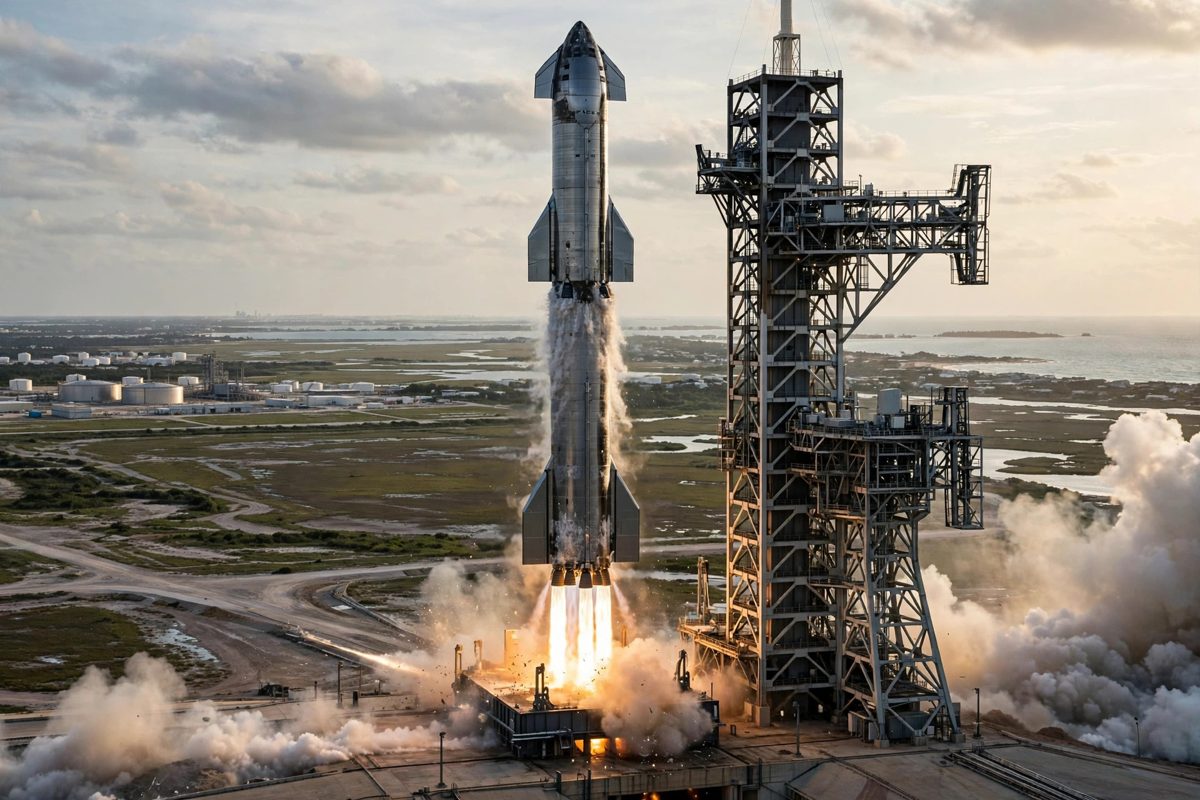
SpaceX launched Starship Flight 15 from Starbase, Texas on Friday evening. The Super Heavy booster missed its planned tower catch and splashed down in the Gulf. Ship 42 has since entered Earth orbit, the second Starship to do so, and all 26 of its Starlink Version 3 satellites have now been deployed.
Key points
- Updated 22:19 UTC, Nov. 14, 2026.
- Reuters reported that the return was the longest flight in orbit yet for Starship, and the first key recovery of the rocket system's centerpiece vessel in the company's effort to build a fully…
- The return followed a hot plunge through the atmosphere.
Updated 22:19 UTC: SpaceX catches Starship Ship 42 at Starbase in a first
Updated 22:19 UTC, Nov. 14, 2026. SpaceX caught Ship 42 in midair on Saturday, the first time a Starship returning from space has been caught by the launch tower arms. The Associated Press reported that the stainless steel spacecraft made its return to Earth 22 hours after it left, and lowered itself upright at the launch pad at Starbase, Texas, where its journey began. SpaceX commentator Dan Huot shouted on the webcast: "Can you believe it?"
Reuters reported that the return was the longest flight in orbit yet for Starship, and the first key recovery of the rocket system's centerpiece vessel in the company's effort to build a fully reusable rocket. Ship 42 circled Earth 14 times, the AP reported, at 165 miles up, with live views of itself and Earth streaming down through Starlink. It had deployed all 26 Starlink Version 3 satellites on Friday night.
The return followed a hot plunge through the atmosphere. Reuters reported that Starship fired one of its engines to begin the descent, slowed from an orbital speed of about 17,000 miles per hour, then reignited three engines to flip itself into a vertical position and steer toward the launch tower, where two mechanical arms, known as the chopsticks, clasped onto the spacecraft as it hovered in place. The AP reported that SpaceX found everything on the spacecraft, including its vital heat shield, appeared to work well.
The catch completed only half of the flight plan. The Super Heavy booster did not come back to the pad on Friday. SpaceX's Kate Tice said its engines stopped firing too soon on the way back down, the AP reported, and the booster's guidance system sensed it was not in the right position and automatically started the watery detour and self-destruction. Wreckage remained in the Gulf of Mexico, cordoned off by buoys, and engineers are still investigating the cause. SpaceX had already caught a Super Heavy booster three times before, the AP reported, and Reuters noted that the company has yet to recover both Starship stages in a single mission.
SpaceX officials said Saturday's catch shows the full reusability of Starship, which is intended for travel to the moon and Mars, the AP reported. NASA welcomed the news. The space agency is paying billions of dollars for Starship to land Artemis astronauts on the moon later this decade and help build a permanent lunar base. SpaceX expects to begin launching Starships from Florida's Kennedy Space Center within the next few months, the AP reported.
SpaceX Starship Flight 15 lifted off from Starbase, Texas at 5:47 p.m. ET on Friday, November 13, 2026. The booster did not come back to the pad. An unknown issue forced SpaceX to abort the Super Heavy booster catch, and the booster splashed down in the Gulf at 5:54 p.m. ET, seven minutes after liftoff, according to Florida Today. The upper stage, Ship 42, kept flying and was coasting in space as the mission continued.
The launch opened a 75 minute window that began at 4:45 p.m. CST. SpaceX had secured its Federal Aviation Administration launch license for Flight 15 only hours before the planned liftoff, according to Reuters. Propellant loading ran on schedule through the afternoon, and SpaceX reported no weather, technical or range issues holding the count.
Update: Ship 42 enters orbit and starts Starlink deployment
SpaceX teams polled GO at 6:12 p.m. ET to send Ship 42 into orbit, Florida Today reported from the SpaceX webcast. Ship 42 entered Earth orbit at 6:15 p.m. ET after a successful insertion burn, the second time a Starship has entered orbit, after Ship 41, according to Florida Today and Starlust. Florida Today reported the words from the webcast: "All looks good with the Ship. A Starship has entered orbit for the second time!" The plan for the Ship in orbit calls for 14 orbits on a 22 hour mission.
Deployment of the Ship's Starlink cargo has begun. The first of the 26 Starlink Version 3 satellites carried by Ship 42 was deployed at 6:25 p.m. ET, Florida Today reported. Deployment continued from there, and a later report confirmed the full batch deployed, as recorded in the update below. The Ship's return and catch attempt are planned for Saturday and remain unconfirmed. SpaceX has not given a cause for the earlier booster catch abort.
Update: all 26 Starlink satellites deployed
All 26 Starlink Version 3 satellites carried by Ship 42 have been deployed, Starlust reported from the SpaceX webcast, and the flight summary on Wikipedia records the Ship in low Earth orbit with all 26 deployed. Deployment began with the first two satellites. Ship 42 then paused deployment and made a 360 degree rotation so the satellites could image its heatshield tiles with onboard cameras, Starlust reported.
SpaceX spokesperson Dan Huot said Ship 42 was cleared to go past the early return checkpoint off the coast of Hawaii, Starlust reported from the webcast. The Ship is expected to remain in orbit for more than 22 hours before returning to Starbase. Its return and catch attempt are planned for Saturday, November 14, and remain unconfirmed. SpaceX has not given a cause for the booster catch abort.
The booster comes down in the Gulf
The flight plan called for Super Heavy Booster 22 to return to Pad 2 at Starbase about six and a half minutes after launch and be caught by the launch tower arms, known as the chopsticks. That return did not happen. Florida Today reported that an unknown issue caused SpaceX to abort the catch, and the booster splashed down in the Gulf instead. SpaceX has not stated a cause, and none has been reported by the outlets covering the flight live.
A splashdown was always one of the stated options. SpaceX said before launch that either stage would be allowed to come down in the water if a catch looked unsafe, with the booster going to the Gulf and the Ship to the Pacific Ocean.
Ship 42 in orbit
Before the orbit decision, Ship 42 was coasting in space at 6:08 p.m. ET while SpaceX teams monitored the vehicle. The decision then went the other way from an early end to the flight: the teams polled GO, and the Ship burned into Earth orbit at 6:15 p.m. ET.
Ship 42 carries the nickname Don't Panic. Its cargo is 26 Starlink Version 3 satellites, carried in a dispenser in the belly of the Ship. The first satellite was deployed at 6:25 p.m. ET, and all 26 were later confirmed deployed. If the Ship stays healthy in orbit, the plan calls for it to remain in space for 14 orbits on a 22 hour mission and return to the launch site about 22.5 hours after launch, at around 3:17 p.m. CST on Saturday, November 14, 2026. The return and catch attempt remain unconfirmed. If a catch at Starbase looks unsafe, splashdown options off Hawaii and Chile remain open.
Why this flight matters
Flight 15 is the 15th Starship flight since 2023 and the second to carry operational Starlink satellites toward orbit. Reuters reported that a successful recovery of both stages would be the first full recovery of an orbital launch system. The booster half of that goal ended with the Gulf splashdown. The Ship half now rests on the return attempt planned for Saturday, which remains unconfirmed.
Florida Today also reported that this could be one of the last Starship test flights from Texas before the program starts flying from Florida. SpaceX has said its launch tower at Kennedy Space Center Pad 39A will be ready to support a launch later this month, and the first Florida flight is expected in the near future.
Timeline
- Nov 13, 2026The 75 minute launch window for Starship Flight 15 opens at 4:45 p.m. CST at Starbase, Texas. SpaceX had secured its FAA launch license hours before the planned liftoff.
- Nov 13, 2026Starship Flight 15 lifts off from Starbase at 5:47 p.m. ET, with Super Heavy Booster 22 and Ship 42, nicknamed Don't Panic, carrying 26 Starlink Version 3 satellites.
- Nov 13, 2026An unknown issue forces SpaceX to abort the Super Heavy booster catch. The booster splashes down in the Gulf at 5:54 p.m. ET.
- Nov 13, 2026Ship 42 is coasting in space at 6:08 p.m. ET. SpaceX teams monitor the vehicle ahead of a decision at about the 26 minute mark on heading to orbit.
- Nov 13, 2026SpaceX teams poll GO at 6:12 p.m. ET to send Ship 42 into orbit. Ship 42 enters Earth orbit at 6:15 p.m. ET after a successful insertion burn, the second Starship to enter orbit, after Ship 41.
- Nov 13, 2026The first of the 26 Starlink Version 3 satellites carried by Ship 42 is deployed at 6:25 p.m. ET. Deployment continues from there.
- Nov 13, 2026All 26 Starlink Version 3 satellites carried by Ship 42 have been deployed, Starlust reported from the SpaceX webcast. SpaceX spokesperson Dan Huot said the Ship was cleared past the early return checkpoint off Hawaii.
- Nov 14, 2026Ship 42 returns to Starbase after 14 orbits and more than 22 hours in space and is caught by the launch tower arms, the first capture of a Starship flying back from space, AP and Reuters reported.
Sources
- Florida Today: SpaceX Starship to launch from Texas today, attempt double catch, live updates
- Spaceflight Now: Live coverage, Starship Flight 15 attempts to recover full vehicle in double launch pad catch
- Reuters via WNFL: SpaceX to attempt first Starship spacecraft recovery on land in 15th flight
- Starlust: Starship Flight 15 live updates from Starbase, Texas
- Wikipedia: Starship flight 15
- Associated Press via NPR Illinois: SpaceX successfully catches Starship and makes history
- Reuters: SpaceX's Starship aces first return to Texas
- Gizmodo: SpaceX Attempts Upper Stage Starship Catch After Booster Explodes