
An Octopus Has Three Hearts, and One Stops When It Swims
Two hearts feed the gills, one feeds the body, and that main heart pauses during a swim. The blue blood explains why the extra pumps exist.
Key points
- An octopus runs on three hearts, and one of them stops beating every time the animal swims.
- Its blood is blue.
- Two of the hearts sit at the base of the gills.
An octopus runs on three hearts, and one of them stops beating every time the animal swims. Its blood is blue. Both facts sound invented. Both are basic octopus biology, confirmed by marine researchers and aquariums that work with these animals every day.
Two hearts for the gills, one for the body
Two of the hearts sit at the base of the gills. Their only job is to push blood through the gills, where the blood drops carbon dioxide and picks up oxygen from the water.
The third heart, called the systemic heart, takes that oxygen rich blood and pumps it out to the rest of the body: the arms, the gut, the skin, the brain. That split is why an octopus can feed a large, active body with a blood system that works very differently from ours.
Why the blood is blue
Human blood is red because it carries oxygen on hemoglobin, a protein built around iron. Octopus blood carries oxygen on hemocyanin, a protein built around copper. When hemocyanin holds oxygen, it turns blue.
Copper based blood handles cold, low oxygen water well, which suits an animal that lives on the seafloor. The trade off is that hemocyanin moves oxygen less efficiently than hemoglobin. Thick, hard to pump blood is one reason the octopus needs extra hearts in the first place. The two gill hearts act as boosters, keeping pressure up where the blood has to squeeze through the fine vessels of the gills.
The heart that quits during a swim
Here is the strange part. When an octopus swims by jet propulsion, squeezing water out of its body to push itself backward, the systemic heart stops beating. Blood flow to the body drops for as long as the swim lasts.
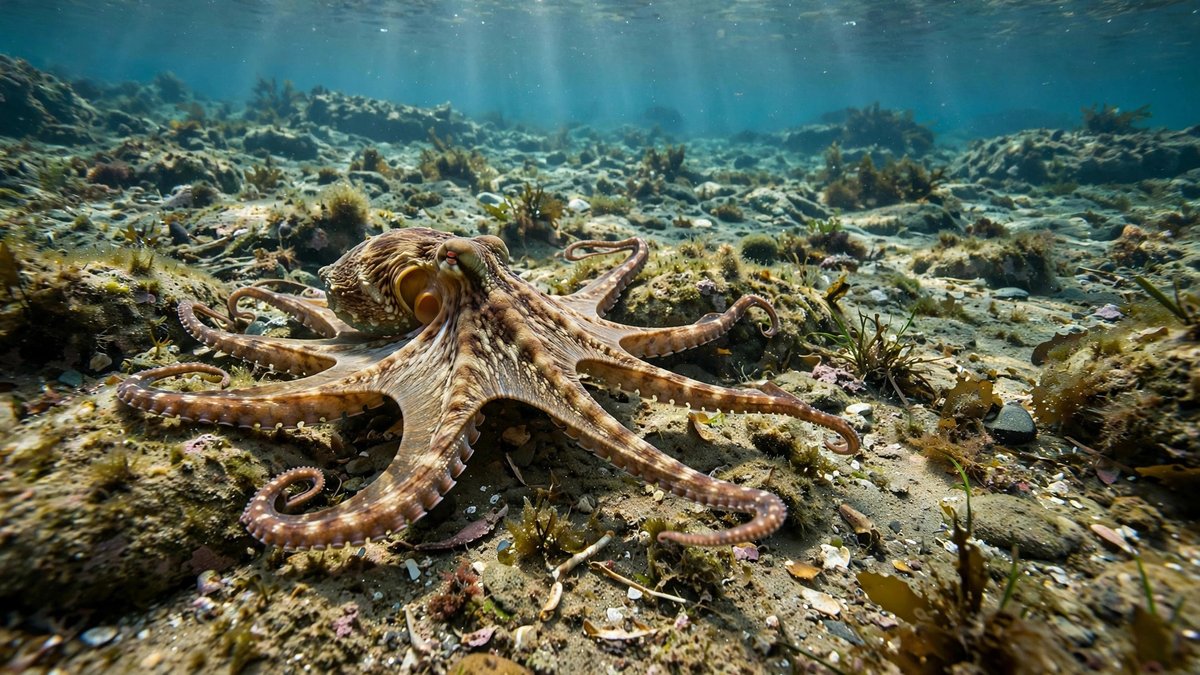
That is a costly way to travel. An octopus that jets around tires fast, because its muscles and organs are running on a paused pump. Researchers point to this as the reason octopuses prefer to crawl. Watch one in an aquarium and it usually walks the seafloor on its arms, slow and deliberate, saving the jet for a quick escape.
A body built around the problem
The rest of the octopus fits the same pattern of workarounds. It has no bones, so it can pour itself through a gap barely wider than its beak, the one hard part of its body. Around two thirds of its nerve cells sit in its arms, not its head, so each arm can feel, taste and react partly on its own.
None of this makes the octopus badly designed. It makes it designed for a different set of problems: cold water, thin oxygen, and a soft body that has to hunt, hide and think without a skeleton. Three hearts and blue blood are not party tricks. They are the plumbing that lets that body work.