
Cleopatra Lived Closer to the iPhone Than to the Great Pyramid
The pyramid was finished about 2,530 years before Cleopatra died. The iPhone came about 2,037 years after her. The math puts her nearer to us.
Key points
- Cleopatra lived closer in time to the first iPhone than to the building of the Great Pyramid of Giza.
- It sounds like a trick.
- The Great Pyramid, built for the pharaoh Khufu, was completed around 2560 BCE.
Cleopatra lived closer in time to the first iPhone than to the building of the Great Pyramid of Giza. It sounds like a trick. It is arithmetic. The pyramid was finished about 2,530 years before Cleopatra died. The iPhone arrived about 2,037 years after she died. She sits almost five centuries nearer to us than to the monument everyone pictures beside her.
The three dates
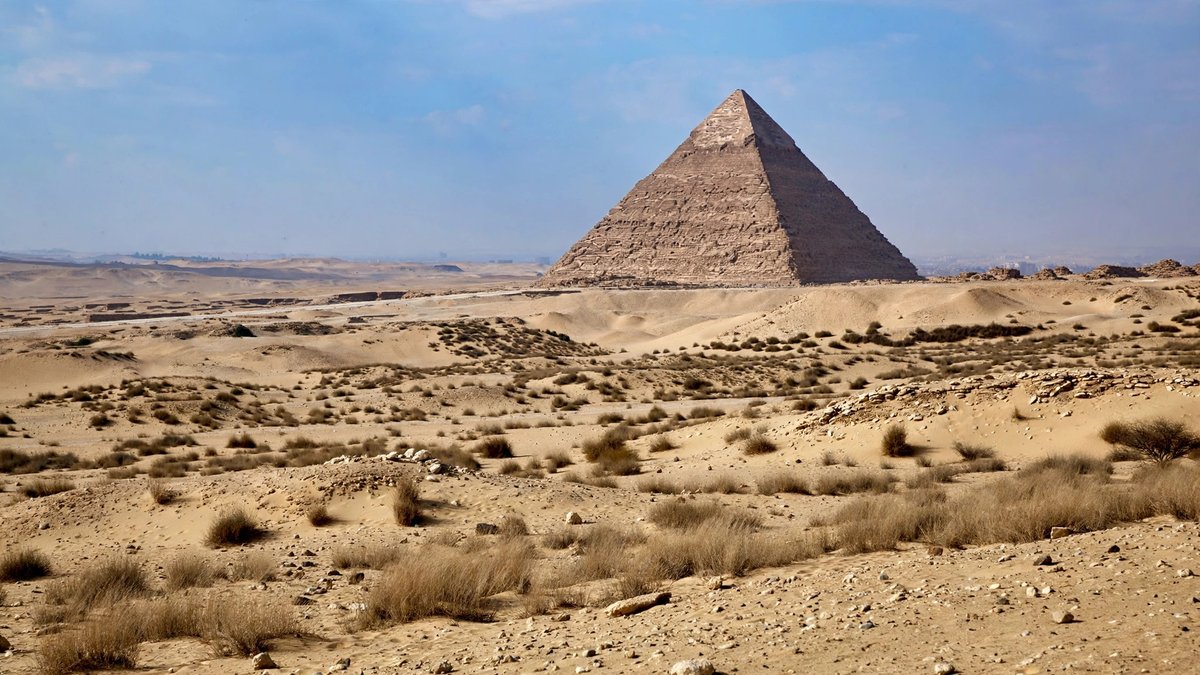
The Great Pyramid, built for the pharaoh Khufu, was completed around 2560 BCE. That date comes from the standard chronology of Egypt's Old Kingdom, the period historians call the pyramid age.
Cleopatra VII, the last active ruler of ancient Egypt, was born in 69 BCE and died in 30 BCE. She ruled from Alexandria, a Greek speaking port city full of scholars, merchants and Roman diplomats.
The first iPhone went on sale on June 29, 2007.
Now do the subtraction. From 2560 BCE to 30 BCE is about 2,530 years. From 30 BCE to 2007 CE is about 2,037 years (there is no year zero, which is why the count is one less than a simple sum). The gap behind Cleopatra beats the gap ahead of her by roughly 490 years.
Why our brains merge them
History teaching compresses ancient Egypt into one flat picture: pyramids, pharaohs, the Nile, Cleopatra. Three thousand years of civilization get filed under a single label, so events separated by millennia feel like neighbors.
They were not neighbors. By Cleopatra's time, the Great Pyramid was already a ruin of deep antiquity. Tourists of her era visited it the way tourists visit it now. Herodotus, the Greek historian who wrote about the pyramid builders, lived about four centuries before Cleopatra, and even he was separated from Khufu by roughly two thousand years.
Cleopatra's own world was late and cosmopolitan. She spoke nine languages by ancient accounts, negotiated with Julius Caesar and Mark Antony, and ruled a kingdom that Rome absorbed the year she died. Almost nothing about her daily life resembled the Old Kingdom world that raised the pyramid.
Flip the comparison
Try it the other way. Julius Caesar, who knew Cleopatra personally, is closer in time to a modern smartphone user than to the pyramid builders. The Roman Empire, which feels ancient to us, stood nearer the pyramid's completion from the other side: Romans looking at the Great Pyramid were looking back across a span longer than the span from Rome's fall to today.
That is the real lesson of the trick. Ancient is not one place. It is a long corridor, and Cleopatra stands near its far end, much closer to the door marked now than to the door marked Khufu.