
This California Tree Was Already Old When the Pyramids Were Built
Methuselah, a bristlecone pine in California, sprouted around 2833 BCE. It was already centuries old when the Great Pyramid went up, and its exact spot is a secret.
Key points
- A pine tree growing on a bare slope in California was already alive centuries before workers began building the Great Pyramid of Giza.
- The tree is a Great Basin bristlecone pine known as Methuselah.
- Bristlecone researchers date trees by counting growth rings in a thin core taken from the trunk, work pioneered in these mountains by Edmund Schulman of the University of Arizona Laboratory of…
A pine tree growing on a bare slope in California was already alive centuries before workers began building the Great Pyramid of Giza.
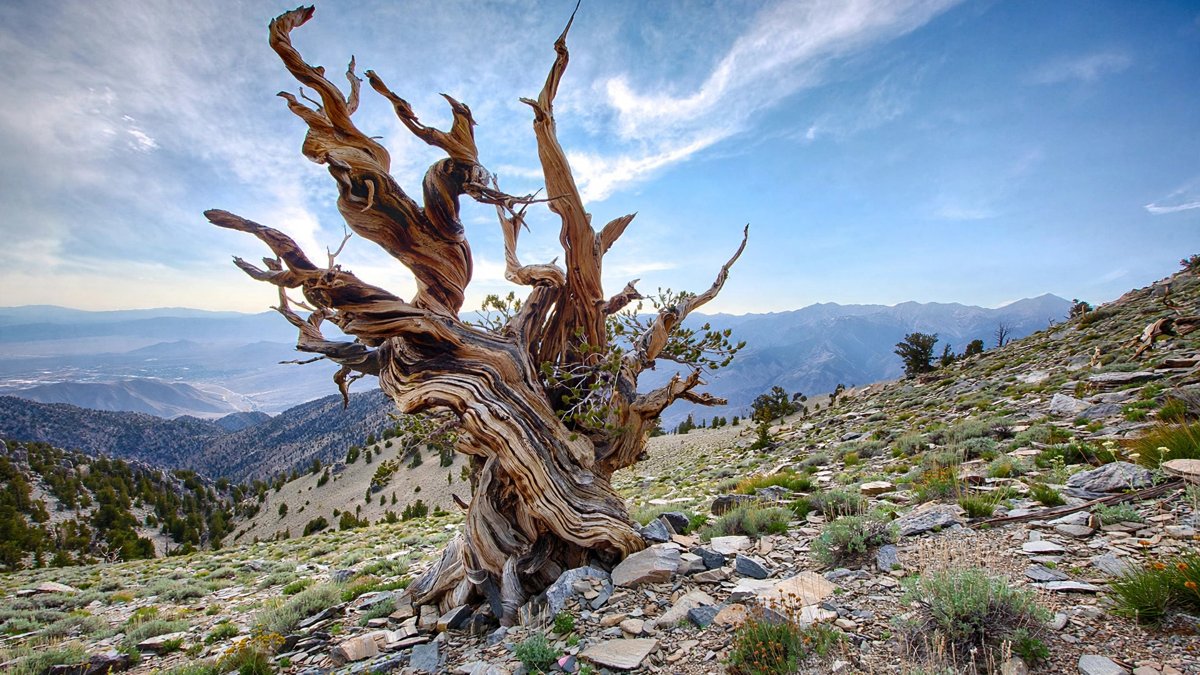
The tree is a Great Basin bristlecone pine known as Methuselah. Tree ring dating puts its first growth at around 2833 BCE. The US Forest Service, which protects the grove where it stands, gives the species a lifespan of almost 5,000 years, and Methuselah is the most famous living example.
A seedling from before the pyramids
Bristlecone researchers date trees by counting growth rings in a thin core taken from the trunk, work pioneered in these mountains by Edmund Schulman of the University of Arizona Laboratory of Tree Ring Research. His count for Methuselah reached back to about 2833 BCE, which works out to roughly 4,855 years old by 2025.
The Great Pyramid was built around 2560 BCE. So when Egyptian workers started stacking stone at Giza, this pine had already been growing for more than 250 years. It was alive when mammoths still walked on Wrangel Island in the Arctic, and it was already ancient when Rome was founded.
The worst soil makes the longest life
Methuselah grows in the White Mountains of eastern California, in the Inyo National Forest, on slopes above 10,000 feet. The soil is thin, rocky dolomite with few nutrients. The wind is hard, the winters are bitter, and the growing season is short.
That hardship is the secret. Bristlecone pines grow extraordinarily slowly, laying down dense, resin rich wood that resists insects, fungi and rot. The Forest Service notes the species survives extremely adverse growing conditions on mountain tops and ridges where faster growing trees cannot hold on. Parts of an old bristlecone can die while a thin strip of living bark keeps climbing the trunk, so the tree carries on with a fraction of itself still alive.
A location kept secret on purpose
You can walk the trail through the Methuselah Grove and pass the tree without knowing it. The Forest Service does not mark it and does not give out its exact location, a deliberate choice to protect it from vandals and souvenir hunters. An earlier record holder, a Nevada bristlecone called Prometheus, was cut down in 1964 before anyone counted its rings and found it even older. Methuselah gets secrecy instead of a sign.
Rings that read like a climate diary
Those rings are more than a birthday count. Each year leaves a ring whose width records the weather that tree lived through, so a living archive almost five millennia long lets scientists read droughts and cold spells from long before written records. Bristlecone ring records from these mountains helped researchers calibrate radiocarbon dating itself.
The tree is still adding rings. Somewhere on a white slope in California, behind no fence and under no sign, the oldest known single tree on Earth is quietly having another year.