
The Axolotl Can Regrow Its Heart, Its Spine and Part of Its Brain
The axolotl rebuilds whole limbs with no scar. It can also regrow parts of its heart, spinal cord and brain, and scientists are reading its genome to learn how.
Key points
- Cut off an axolotl's leg and it grows a new one, bone, muscle, nerves and skin, with no scar where the old leg ended.
- That is only the start of the list.
- The axolotl is a salamander that skips the usual adult stage.
Cut off an axolotl's leg and it grows a new one, bone, muscle, nerves and skin, with no scar where the old leg ended.
That is only the start of the list. This small Mexican salamander can also rebuild parts of its heart, sections of its spinal cord, and even pieces of its brain. Smithsonian Magazine and Scientific American both describe the same animal, and the same almost unreasonable ability: the axolotl does not patch damage, it replaces what was lost.
A salamander that never grows up
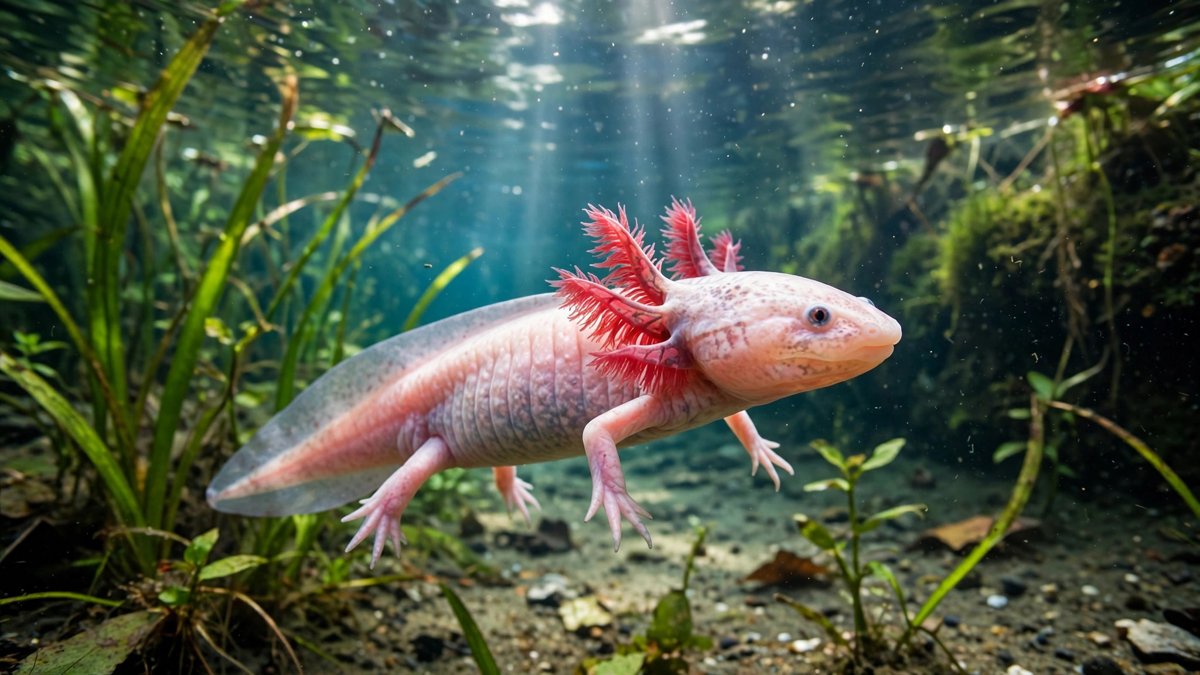
The axolotl is a salamander that skips the usual adult stage. Most salamanders lose their gills and move onto land. The axolotl keeps its feathery external gills, its finned tail and its life in the water for its whole life, a condition scientists call neoteny. It reaches full adult size and breeds while still looking like a larva.
In the wild it lives in one place only, the canal system of Lake Xochimilco near Mexico City, and it is critically endangered there. The animal that laboratories around the world study for regeneration is running out of its home water.
How a leg comes back
When an axolotl loses a limb, it first seals the wound with a special skin called wound epithelium. Under that cover, cells gather into a small bud of tissue called a blastema. The blastema then grows into a complete new limb, at the right size and pointing the right way. Within weeks, Smithsonian Magazine reports, the seam between old and new tissue disappears completely.
The same rebuilding reaches inside the body. Axolotls can regenerate ovary and lung tissue and parts of the brain and spinal cord. Scientific American reports that they recover from crushing injuries to the spinal cord, and that researchers have watched them regrow a small square of the forebrain. Work in one laboratory has found that the heart, lungs and ovaries can all grow back after injury too.
Why scientists care so much
Humans share many of the same genes, including the ones involved in building a limb in the first place. The difference is what happens after injury: a human wound closes with a scar, while an axolotl wound reopens the instructions for building the part again. With the axolotl genome now sequenced, a giant genome by animal standards, researchers can compare those instructions directly.
Nobody honest promises human limb regrowth on a date. What the axolotl offers is narrower and real: proof that a backboned animal can rebuild complex parts without scarring, and a living set of instructions for how it is done. The medicine may take decades. The animal does it in weeks, quietly, in a tank or a canal, wearing the same mild smile it always wears.