
Why Toast, Steak Crust and Coffee Taste That Way: One Reaction Builds Hundreds of Flavors
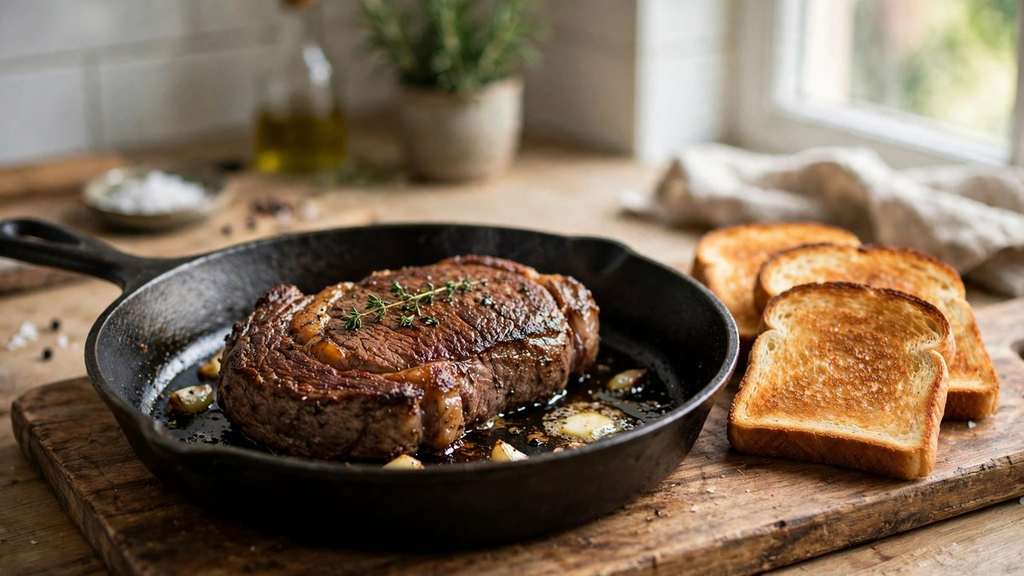
The brown crust on bread, the sear on a steak and the roast on coffee beans come from the same chemistry. Amino acids meet sugars under heat, and the reaction writes a new menu of flavors that were not in the raw food.
Key points
- Raw bread dough tastes bland.
- The reaction is named for Louis-Camille Maillard, a French chemist who described amino acids reacting with sugars in 1912.
- The cascade can start at lower heat, but it runs rapidly at about 140 to 165 degrees Celsius, 280 to 330 degrees Fahrenheit.
Raw bread dough tastes bland. Toast it and the slice turns sweet, nutty and deep. A pale steak tastes mild. Sear it and the crust turns rich and savory. Nothing was added in either case. Heat ran a reaction between compounds already in the food, and that reaction created the flavor.
A cascade, not a single reaction
The reaction is named for Louis-Camille Maillard, a French chemist who described amino acids reacting with sugars in 1912. It is not one reaction but a cascade. Amino acids, the building blocks of protein, meet reducing sugars under heat. Their first products rearrange and react again, and the chain ends in part with melanoidins, large brown pigments that give toast, bread crust, beer and roasted coffee their color. The same cascade creates hundreds of different flavor compounds, and those compounds break down and form still more. Because every food starts with a different mix of amino acids and sugars, every food ends with its own set of flavors. That is why steak crust, bread crust and coffee share a family resemblance and still taste nothing alike.
Heat needs a dry surface
The cascade can start at lower heat, but it runs rapidly at about 140 to 165 degrees Celsius, 280 to 330 degrees Fahrenheit. Water holds it back. A wet surface cannot climb much past the boiling point of water, 100 degrees Celsius, until the water cooks off. That is why poached chicken stays pale, as the Science Museum of Virginia points out, and why steamed food does not brown. It is also why cooks pat a steak dry before it hits the pan. A dry surface reaches browning heat fast. A wet one spends its first minutes making steam.
Not the same as caramel
Browning sugar alone is a different reaction, called caramelization. It needs no protein, and table sugar starts to caramelize at around 320 degrees Fahrenheit and up, higher than the Maillard range, with the exact point varying by sugar. Caramel flavor is its own thing. Many foods run both reactions at once, which is one reason a cookie, with sugar, fat and flour in the oven together, tastes more complex than either reaction explains alone.
Maillard was not chasing dinner. He was studying how amino acids and sugars react, work tied to his attempt to reproduce how living cells build protein. A century later his result runs every bakery, grill and coffee roaster on Earth, and it explains a daily kitchen fact: browned food tastes deeper because the heat built new flavor molecules that the raw food never had. The same reaction family browns bread, cookies, cakes, popcorn and cooked rice, which is why one piece of chemistry shows up at almost every meal.