
Honolulu, Hawaii: Supreme Court Hears Whether Zoo Elephants Mari and Vaigai Can Challenge Their Captivity
Justices questioned lawyers about octopuses, aliens and precedent on Monday as the Nonhuman Rights Project asked the Hawaii Supreme Court to let the Honolulu Zoo elephants bring a habeas corpus case.
Key points
- The Hawaii Supreme Court heard arguments on Monday at Punahou School in Honolulu, in front of about 500 students from 11 Oahu schools.
- The Nonhuman Rights Project filed the petition in 2023, asking that Mari and Vaigai be moved from the zoo to an accredited elephant sanctuary.
- Lawyers for the Nonhuman Rights Project told the court that Mari and Vaigai are intelligent, self-aware and autonomous.
The Hawaii Supreme Court heard arguments on Monday at Punahou School in Honolulu, in front of about 500 students from 11 Oahu schools. The case is Mari and Vaigai, two Asian elephants at the Honolulu Zoo. The question before the justices is whether the elephants can bring a habeas corpus case, the legal process a person uses to challenge unlawful detention, against the city that keeps them.
How the case reached the court
The Nonhuman Rights Project filed the petition in 2023, asking that Mari and Vaigai be moved from the zoo to an accredited elephant sanctuary. Lower courts dismissed the petition, and the Hawaii Intermediate Court of Appeals upheld the dismissal in January 2026, ruling that the elephants do not meet the definition of persons under the habeas corpus statute. The Supreme Court agreed in June to review that ruling. The case is Nonhuman Rights Project v. C&C of Honolulu, SCWC-24-0000323, and Monday's hearing was held under the Judiciary's Courts in the Community program.
The argument for the elephants
Lawyers for the Nonhuman Rights Project told the court that Mari and Vaigai are intelligent, self-aware and autonomous. "The world's foremost elephant scientists have established that Mari and Vaigai are autonomous," attorney Jake Davis said. "Autonomy is the foundation of the right to liberty." Davis argued that habeas corpus is handled case by case, and that a ruling for the elephants would only entitle them to a hearing on whether their confinement is lawful.
The city answers
Patricia Sendao, a deputy corporation counsel for the City and County of Honolulu, argued that the change the project wants is one for the state Legislature, not the courts. "What is asked for here by NhRP is a sweeping pronouncement that fundamentally alters our laws regarding animal welfare," she said. City lawyers argued the idea has been rejected by other courts and that existing laws protect zoo animals. Honolulu Zoo director John Berry said in a letter that the welfare of the zoo's two elephants "has been and will remain one of the highest priorities of the Honolulu Zoo."
Octopuses, aliens and a cartoon
The justices pressed both sides on where a ruling would stop. "Don't octopuses have autonomy? Are you going to at least limit it to mammals, or are you talking about reptiles, amphibians, insects? What are we talking about?" Associate Justice Sabrina McKenna said. Associate Justice Todd Eddins asked about a character from The Flintstones, the alien called the Great Gazoo, and whether an intelligent alien could ever challenge confinement if habeas corpus stays limited to persons. Sendao answered that the people of Hawaii should decide so large a shift, not one court case.
The elephants at the center of it
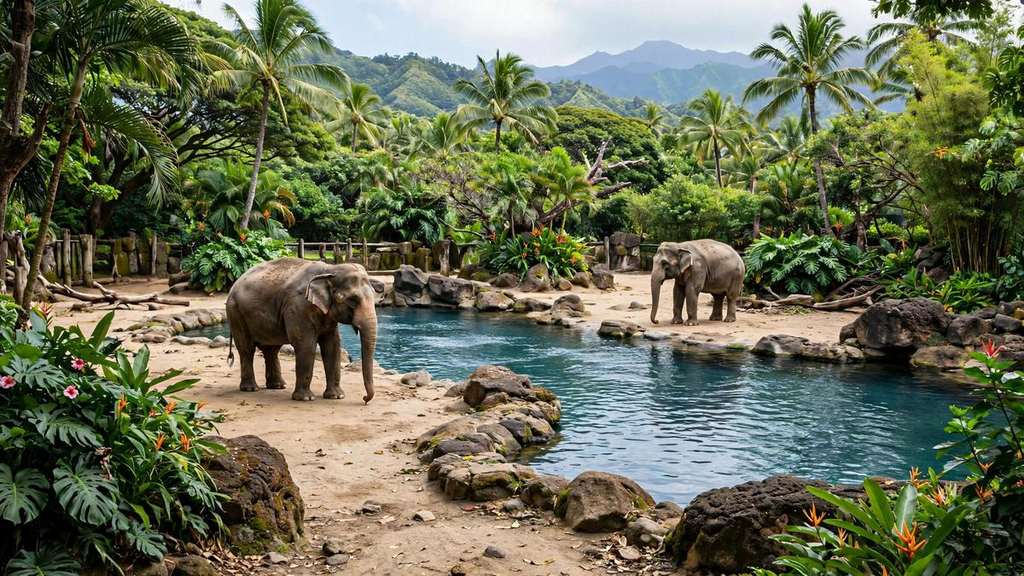
Mari is 51 and Vaigai is 40, Hawaii News Now reported. Both are wild-born and have lived at the zoo for more than 30 years each. Their enclosure is two and a half acres, about 15 years old, with two deep swimming pools and separate housing areas. Animal welfare organizations consider it inadequate, Hawaii News Now reported.
What happens next
The court took no action on Monday and gave no date for a decision. If the justices side with the project, Mari and Vaigai would be entitled to a hearing on whether their detention is illegal or cruel, the step their advocates need before any move to a sanctuary could be ordered. If the court upholds the dismissal, the elephants stay at the zoo.
Timeline
- 2023The Nonhuman Rights Project files a habeas corpus petition seeking the transfer of Honolulu Zoo elephants Mari and Vaigai to an accredited sanctuary. Lower courts later dismiss the petition.
- Jan 2026The Hawaii Intermediate Court of Appeals upholds the dismissal, ruling the elephants are not persons under the habeas corpus statute.
- Jun 2026The Hawaii Supreme Court agrees to review the case, Nonhuman Rights Project v. C&C of Honolulu, SCWC-24-0000323.
- Nov 9, 2026The Supreme Court hears oral arguments at Punahou School in Honolulu before about 500 students from 11 Oahu schools. The court takes no action and gives no date for a decision.