
This Sea Slug Steals Chloroplasts From Its Food and Then Lives on Sunlight for Months
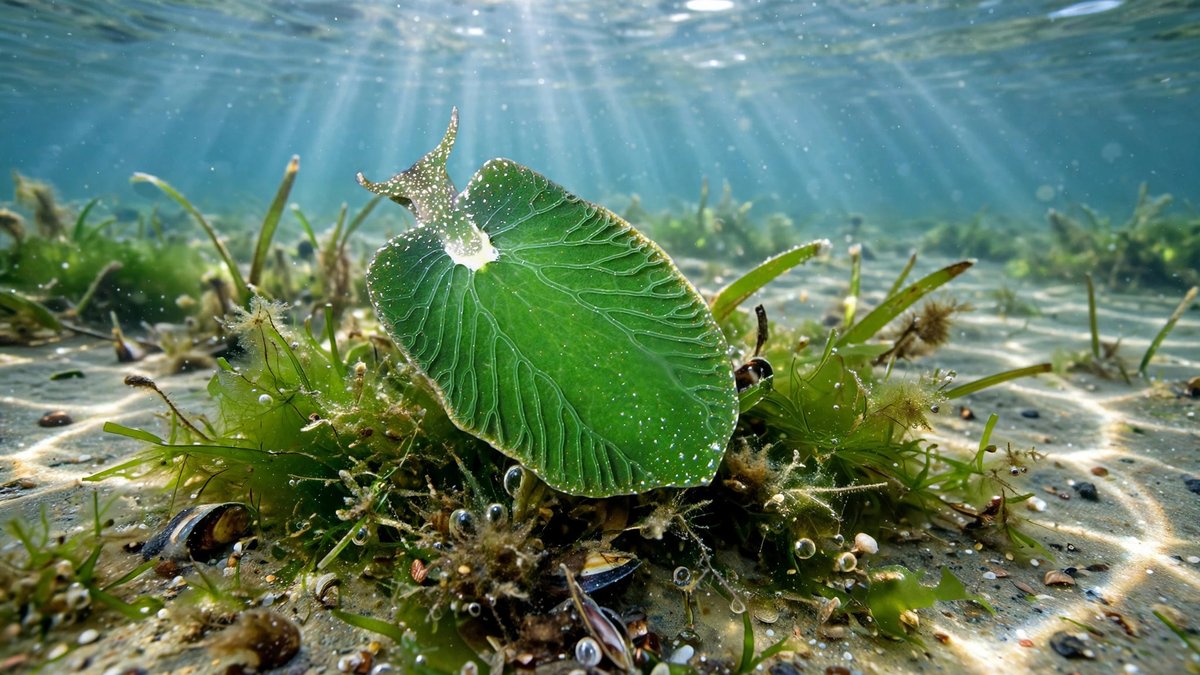
Elysia chlorotica eats an alga, keeps its chloroplasts working inside its own cells for up to nine months, and lives on the food they make from sunlight. Scientists still argue over whether it stole genes too.
Key points
- The emerald sea slug does something animals are not supposed to do.
- The trick has a scientific name, kleptoplasty, which means stealing plastids.
- Those stolen chloroplasts are packed into cells lining the slug's digestive system, and they keep working.
The emerald sea slug does something animals are not supposed to do. It eats an alga, keeps the alga's solar panels instead of digesting them, and then runs on sunlight for months. The slug, Elysia chlorotica, is bright green and shaped a little like a leaf. After one good feeding, it can go the rest of its adult life of about eight or nine months without another meal.
Theft, then storage
The trick has a scientific name, kleptoplasty, which means stealing plastids. The slug feeds on a thread like alga called Vaucheria litorea. It pierces the alga with a sharp tooth, sucks out the cell contents and digests almost all of it. The exception is the chloroplasts, the green structures that run photosynthesis in plants and algae.
Those stolen chloroplasts are packed into cells lining the slug's digestive system, and they keep working. In the alga they would not last long on their own. Inside the slug they can photosynthesize for up to nine months, far longer than they manage in their original home, according to research reported by the Marine Biological Laboratory. Their output, carbohydrates and lipids made from sunlight, water and carbon dioxide, feeds the slug.
The gene question
Keeping a stolen chloroplast alive should be hard. Chloroplasts depend on proteins coded by genes in the alga's own nucleus, and the slug digests that nucleus. Yet the machinery keeps running, which pushed researchers to ask whether the slug had taken genes as well as parts.
In a study published in The Biological Bulletin, a team used fluorescent markers to track algal DNA in the slug and reported finding an algal gene on a slug chromosome. The gene helps maintain the chloroplasts, and the team reported that it passes to the next generation of slugs. Reporting on the work, Smithsonian Magazine called the slug a true plant animal hybrid.
The honest caveat is that the gene transfer story is still argued over. A later scientific review of photosynthetic sea slugs notes that clear evidence for horizontal gene transfer is lacking, and that the slugs may simply be very good at protecting and housing the stolen parts. Both sides agree on the core fact. The chloroplasts work, for months, inside an animal.
Born needing one meal
The system is not self starting. Young slugs arrive without chloroplasts and must feed on the alga to collect them. Research reviewed in the journal Cytologia found that the slug cannot complete its development into an adult without taking up plastids from its food. Each generation has to steal its own solar panels.
That is what makes the animal so strange to biologists. Photosynthesis is the defining trick of plants and algae, guarded by a full support system of genes. A small green slug in shallow coastal water borrowed the end product and kept it running through most of its life. Whether it also borrowed the instruction manual is a question labs are still fighting over, and the fight itself tells you how unusual the animal is.