
Washington, DC: Trump Proclaims the Oval Office a National Monument
President Donald Trump signed a proclamation on November 5 making the Oval Office, the Outer Oval Office and the Cabinet Room a national monument under the Antiquities Act, two days after Democrats won control of Congress.
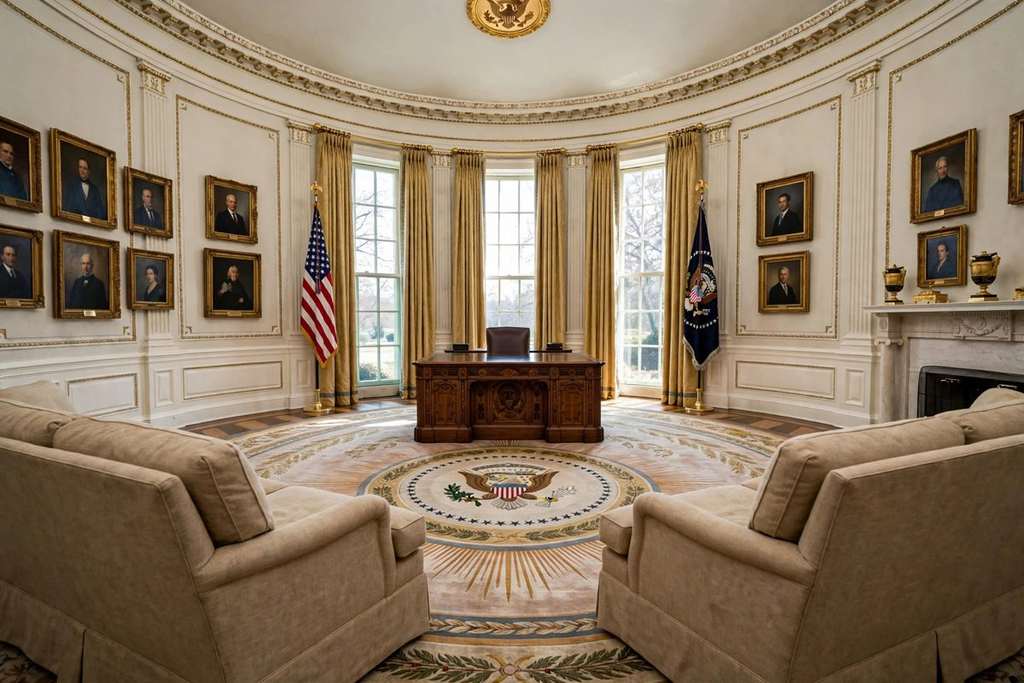
Key points
- President Donald Trump signed a proclamation on Thursday, November 5, 2026, establishing the Oval Office as a national monument, a step he said will stop future presidents from reshaping the West…
- "We are making it a national monument and it will not be allowed to be touched by anybody," Trump told reporters in the Oval Office, according to the Associated Press.
- The proclamation, published by the White House on Thursday, says the monument consists of the Oval Office itself, Room 110, together with the Outer Oval Office, Rooms 106 and 108, and the Cabinet…
President Donald Trump signed a proclamation on Thursday, November 5, 2026, establishing the Oval Office as a national monument, a step he said will stop future presidents from reshaping the West Wing rooms he has redecorated.
"We are making it a national monument and it will not be allowed to be touched by anybody," Trump told reporters in the Oval Office, according to the Associated Press. He called the two rooms "a landmark for the ages" and said the designation would "make it impossible for anybody ever to destroy this incredible space," CNN reported. Trump said major modifications would need approval from Congress, and that the administration would send the document to Congress to have it ratified.
What the proclamation covers
The proclamation, published by the White House on Thursday, says the monument consists of the Oval Office itself, Room 110, together with the Outer Oval Office, Rooms 106 and 108, and the Cabinet Room, Room 105. Trump issued it under the Antiquities Act, citing section 320301 of title 54 of the United States Code.
The Secretary of the Interior, through the National Park Service, will manage the monument. The proclamation orders a management plan that puts preservation first, requires documentation, review and a look at alternatives before any work that would substantially alter or demolish the monument, and requires that proposed changes be judged against the rooms and their national significance. The Interior Secretary must also coordinate with the Committee for the Preservation of the White House.
The order has limits written into it. It does not restrict a president from redecorating the rooms, choosing furnishings, or making ordinary operational and security changes that do not substantially harm the historic structure. It does not change existing exemptions for the White House under the National Historic Preservation Act, and it does not reduce the authority of Congress over federal property.
A room with a long history
The proclamation says the Oval Office took its present location and form during the administration of President Franklin D. Roosevelt. Its oval design was first introduced in the West Wing under President William Howard Taft and was refined in the early 1930s. The White House and its grounds are federal property, administered as part of President's Park by the National Park Service, and are already recognized as a National Historic Landmark. The White House fact sheet said the room has served as the principal working office of the president for almost a century.
Trump has put his own mark on the room. Since returning to the White House he has filled wall space with portraits, added a copy of the Declaration of Independence and added numerous golden accents, the Associated Press reported. CNN listed gold figurines on the mantle, medallions on the fireplace, gold eagles on the side tables, gilded mirrors and small gold cherubs above the doorways.
A third day focused on building projects
The signing came two days after voters delivered control of both the House and the Senate to Democrats in the November 3 midterm elections. It was the third day this week in which Trump held an event about one of his Washington building projects. On November 4 he marked the final beam of his new White House ballroom, and on the eve of the election he gave his closing pitch at the Lincoln Memorial Reflecting Pool. Democrats have said the incoming majority will scrutinize the projects. Jon Gollinger of Public Citizen, a group opposing several of them, told USA Today that Congress has to "litigate, investigate and legislate."
Timeline
- Early 1930sThe Oval Office takes its present location and form during the administration of President Franklin D. Roosevelt, refining an oval design first introduced in the West Wing under President William Howard Taft.
- Nov 3, 2026Democrats win control of both the House of Representatives and the Senate in the midterm elections.
- Nov 4, 2026Trump marks the final beam of his new White House ballroom at a ceremony on the construction site.
- Nov 5, 2026Trump signs a proclamation establishing the Oval Office, the Outer Oval Office and the Cabinet Room as the Oval Office National Monument.
Sources
- The White House: Establishment of the Oval Office National Monument
- The White House: Fact Sheet: President Donald J. Trump Establishes the Oval Office as a National Monument
- Associated Press via KCAU 9: Trump signs proclamation he says will prevent future changes to the Oval Office and Cabinet Room
- CNN: Trump says he is declaring Oval Office and Cabinet Room national landmarks to prevent future changes
- USA Today: Trump takes executive action to preserve his changes to Oval Office