
Voyager 1 Will Be One Light Day From Earth on November 18
NASA says the 49 year old probe will reach 16.094 billion miles from home next week, so far that a radio signal needs a full day to reach it.
Key points
- On November 18, a radio signal from Earth will need a full day to reach Voyager 1.
- One light day is the distance light travels in 24 hours, about 25.9 billion kilometres.
- Engineers talk to Voyager through NASA's Deep Space Network, a set of large antennas around the world.
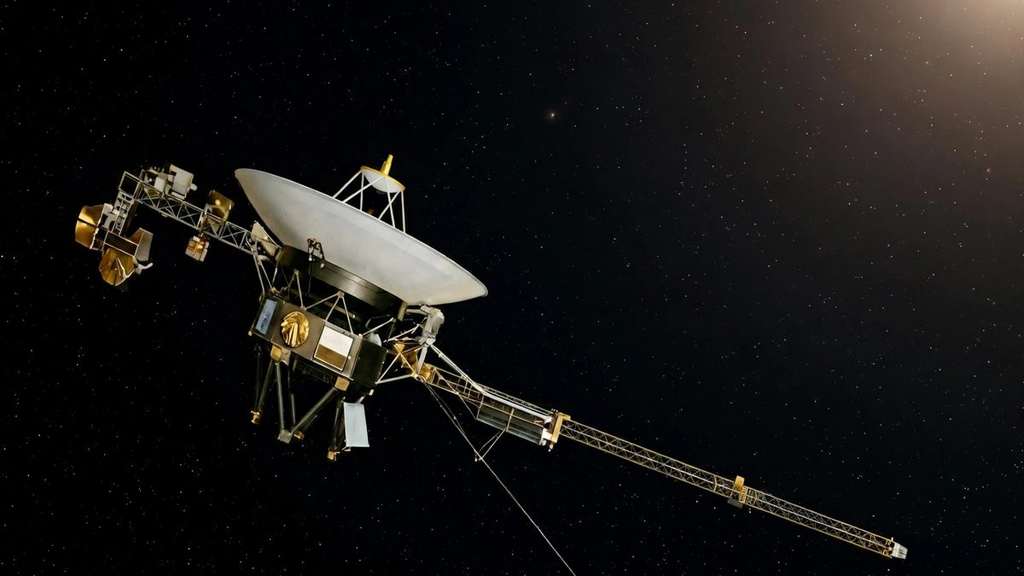
On November 18, a radio signal from Earth will need a full day to reach Voyager 1. NASA says the probe will cross one light day from home at 5:16 a.m. Eastern time that morning, 16.094 billion miles away, the first human made object to get that far.
One light day is the distance light travels in 24 hours, about 25.9 billion kilometres. Nothing on the spacecraft changes when it crosses the line. The mark is a measure of distance, and of how long the mission has lasted. Voyager 1 launched from Cape Canaveral, Florida, on September 5, 1977. It has flown for 49 years.
A signal that takes a day
Engineers talk to Voyager through NASA's Deep Space Network, a set of large antennas around the world. From November 18, a command sent to the probe will arrive a day later, and any answer will take another day to come back. The spacecraft already works in interstellar space, beyond the bubble of particles and magnetic fields that surrounds the Sun. It crossed into that region in 2012.
Power is the limit on how long it can keep reporting. The probe runs on a shrinking supply from its plutonium generators, and the team has switched instruments off over the years to save energy for the ones still sending data home.
A torch lit send off
NASA is marking the week with the public. Its Shine Bright for Voyager event asks people around the world to go outside after sunset on Tuesday, November 17, point a torch or a phone light at the sky, and flash the letters V, G and R in Morse code, the mission's call sign. The probe is far too distant to see. On that night it sits in the direction of the constellation Ophiuchus, low in the west after sunset for northern observers.
Why it matters
Voyager 1 and its twin Voyager 2 are the only spacecraft working outside the Sun's bubble. Their readings are the only direct measure of the space between stars that Earth has. Every extra month of data is new ground, because no other probe is out there to take it. The light day mark gives that fact a number people can hold: a full day for light itself, travelling at the fastest speed there is, to cover the distance a machine built in the 1970s has flown.
Timeline
- Sep 5, 1977Voyager 1 launched from Cape Canaveral, Florida.
- Nov 18, 2026Voyager 1 reaches one light day from Earth, 16.094 billion miles away, at 5:16 a.m. Eastern time.