
India Reaches 103 Ramsar Sites as Sukhna and Sauj Jheel Join List
Sukhna Wetland in Chandigarh and Sauj Jheel in Uttar Pradesh have joined the Ramsar list of wetlands of international importance, taking India's total to 103 sites.
Key points
- India now has 103 wetlands on the Ramsar list, the global register of wetlands of international importance.
- Sukhna is Chandigarh's first Ramsar site.
- That mix is why the site qualifies.
India now has 103 wetlands on the Ramsar list, the global register of wetlands of international importance. Environment Minister Bhupender Yadav announced on October 15 that Sukhna Wetland in Chandigarh and Sauj Jheel in Uttar Pradesh are the newest additions. Sukhna is site number 2602 on the list and Sauj Jheel is site number 2603.
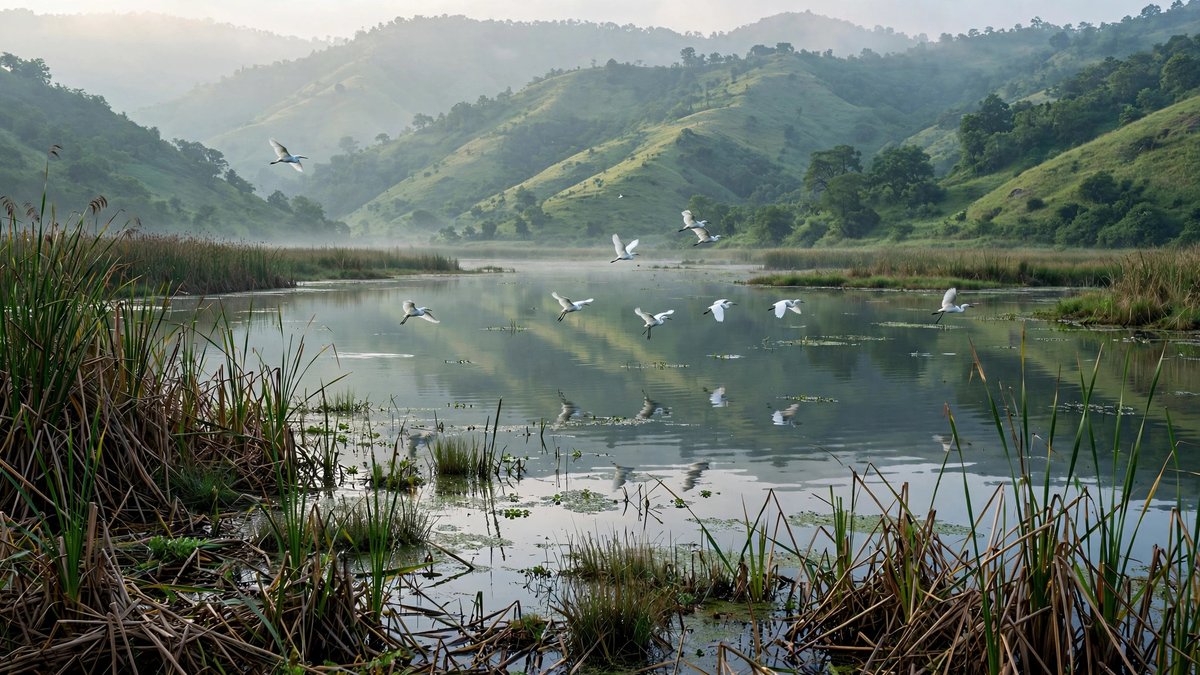
Sukhna is Chandigarh's first Ramsar site. The wetland is a man made reservoir at the edge of the city, at the foothills of the Outer Himalayas. It was created in 1958 by damming the seasonal Sukhna Choe stream, and it covers about three square kilometres. The reservoir holds back sediment and water flowing down from the catchment above the city, and its shores mix open water, reed beds, scrub and forest.
That mix is why the site qualifies. Sukhna sits on the Central Asian Flyway, the migration route used by waterbirds crossing the continent. It gives resident and visiting birds places to feed, breed, roost and spend the winter. Species recorded there include the vulnerable common pochard, the endangered Pallas's fish eagle and the endangered black pond turtle, which lives in the shallow edges of the lake.
A floodplain lake in Uttar Pradesh
Sauj Jheel is a different kind of wetland. It is a shallow lake in farmland on the floodplain of the Ganga River, in Mainpuri district of Uttar Pradesh, close to the Saman Bird Sanctuary. The Ramsar listing says the lake regularly supports more than 30,000 waterbirds. It has been named an Important Bird and Biodiversity Area by BirdLife International. Its plant life includes sacred lotus and wild sugarcane, which give birds and other animals cover for nesting and breeding. Species linked to the site include the sarus crane and the greater spotted eagle.
Sauj Jheel is Mainpuri's second Ramsar site, after the Saman Bird Sanctuary. GKToday notes that Mainpuri is now the only district in Uttar Pradesh with two sites on the list.
What the listing means
A Ramsar listing is not a ban on using a wetland. It is a commitment to manage the site so its ecological character does not decline, and it brings monitoring, scientific attention and often funding with it. India joined the Ramsar Convention on February 1, 1982. The convention itself was adopted in the Iranian city of Ramsar in 1971 and came into force in 1975.
For the two new sites, the work is practical. At Sukhna, the listing points to catchment care, control of silt building up in the reservoir and removal of invasive weeds. At Sauj Jheel, the focus is on fishing rules, including limits on fine mesh nets, and on managing grazing at the lake edge. Both sites store water, soften floods and support people who live from fishing, farming and visitors, as well as the birds the listing is meant to protect.
Timeline
- Oct 15, 2026Environment Minister Bhupender Yadav announces Sukhna Wetland and Sauj Jheel have joined the Ramsar list, taking India's total to 103 sites.
- Feb 1, 1982India becomes a party to the Ramsar Convention, the international treaty for the conservation and wise use of wetlands, adopted in Ramsar, Iran, in 1971.