
No, You Cannot See the Great Wall of China From the Moon. Astronauts Have Checked.
NASA says the wall is not visible from the Moon and is difficult or impossible to see from Earth orbit without high powered lenses. Length is not what the eye reads at that distance. Width and contrast are.
Key points
- No. You cannot see the Great Wall of China from the Moon, and astronauts have looked.
- The claim sounds right because the wall is so long.
- The wall is not invisible to machines.
No. You cannot see the Great Wall of China from the Moon, and astronauts have looked. NASA states the point plainly: the wall is not visible from the Moon, and from Earth orbit it is difficult or impossible to see without the high powered lenses used for station photography.
Why length does not save it
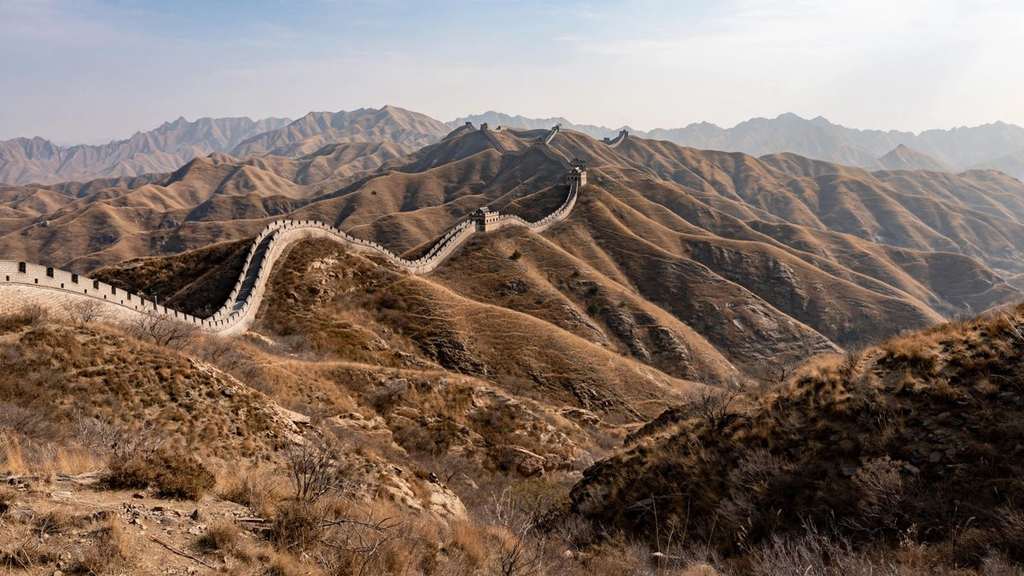
The claim sounds right because the wall is so long. Length is the wrong measure. What the eye picks out at a distance depends on width and contrast. The wall is only a few meters wide in most places, and it is built from local stone and earth that match the hills and ridges it crosses. From orbit it follows the same colors and the same curves as the ground under it. Astronaut Chris Hadfield put it in one line: the wall is too narrow, and it follows the natural contours and colors of the ground. China first astronaut, Yang Liwei, said after his 2003 flight that he did not see it. Apollo astronauts reported continents, lakes and weather from the Moon, not any human structure.
Cameras can do what eyes cannot
The wall is not invisible to machines. In 2004, astronaut Leroy Chiao photographed a section in Inner Mongolia from the International Space Station with a zoom lens. NASA experts later said the photo appears to show the wall, and Chiao himself said he did not see it with his unaided eye and was not sure at the time what the picture held. Radar makes the point even clearer. NASA radar images from the space shuttle pick out wall segments with ease because radar reads the shape and surface, not the color the eye depends on. Snow and low sun can also help a camera by throwing a shadow line. None of that rescues the schoolbook claim, which was always about a person looking.
The claim is older than spaceflight
The story was in print long before any person left Earth. Versions ran in the 1700s, and a 1932 Ripley Believe It or Not cartoon repeated it decades before the first satellite. No astronaut saw the wall and came home with the tale. The tale came first, and every astronaut since has been asked to check it.
What astronauts actually see easily
Plenty of human work stands out from orbit. Cities show up as bright patches, and at night their lights form clear patterns. Straight highways, long bridges, airports, dams and reservoirs cut lines that the eye reads fast because they contrast with the ground around them. The pyramids at Giza are also reported as fairly easy to spot. The lesson is plain. From space, contrast beats size. The longest wall on Earth hides in its own hills, while a straight road across a desert announces itself at once.