
Delhi Air Hits 368 as Severe Hotspots Spread Before Diwali
Delhi's average index stayed very poor on Thursday while 22 stations sat in the severe band on Wednesday. Stubble smoke is rising and forecasters expect severe air on November 6 and 7.
Key points
- Delhi woke to its worst stretch of air this season on Thursday, and the forecast says the hardest days are still ahead.
- The citywide average hides how bad the worst neighborhoods are.
- The Decision Support System, which estimates the sources of Delhi's pollution, put stubble burning at 20.2 percent of the city's pollution on Wednesday and transport emissions at 15.5 percent.
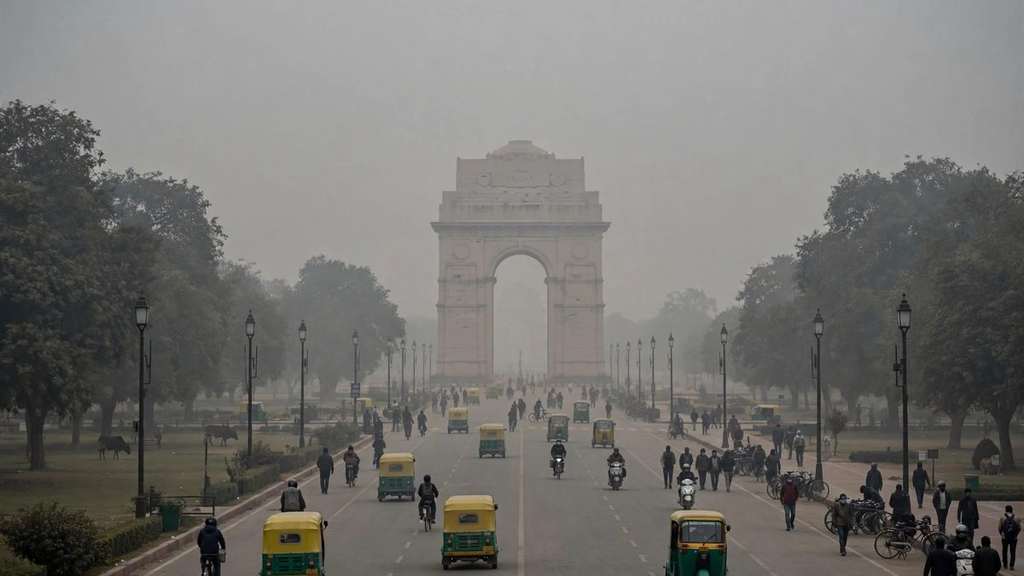
Delhi woke to its worst stretch of air this season on Thursday, and the forecast says the hardest days are still ahead. The city's 24 hour average air quality index stood at 368 on Thursday, in the very poor band, after a reading of 377 on Wednesday. Around the Nauroji Nagar Ring Road, the index reached 416 on Thursday morning, inside the severe band, news agency ANI reported, citing Central Pollution Control Board data. The city is heading into the Diwali weekend with pollution rising, farm fire smoke drifting in from Punjab, and almost no wind to clear it.
The hotspots are already severe
The citywide average hides how bad the worst neighborhoods are. On Wednesday, 22 of the capital's 59 monitoring stations recorded severe air, 32 recorded very poor air and five recorded poor air. The IIT Delhi station read 458, the highest in the city. Jahangirpuri and Punjabi Bagh each read 448, Mundka read 439, Vivek Vihar read 436 and Rohini read 432. Narela and Alipur each read 429, Sonia Vihar read 427 and ITO read 411. On the Central Pollution Control Board scale, 0 to 50 is good, 101 to 200 is moderate, 201 to 300 is poor, 301 to 400 is very poor and 401 to 500 is severe.
Where the smoke is coming from
The Decision Support System, which estimates the sources of Delhi's pollution, put stubble burning at 20.2 percent of the city's pollution on Wednesday and transport emissions at 15.5 percent. One report on the data said local sources inside Delhi accounted for 31 percent, while sources outside the capital contributed 69 percent. Delhi's environment minister blamed farm fires in Punjab, ruled by the Aam Aadmi Party, for the spike. The Commission for Air Quality Management has issued show cause notices to the deputy commissioners and senior police officials of five Punjab districts over the burning, according to a report on the agency's actions.
The rules now in force
Stage II of the Graded Response Action Plan has been in force across Delhi and the National Capital Region since November 2, after Stage I began on October 21. Stage II tightens dust control at construction sites, requires mechanised sweeping and targeted water sprinkling, and steps up checks on open burning and visibly polluting vehicles. The city's winter plan, in force since November 1, restricts private construction work through January 31, with a complete ban scheduled from December 10 to January 20. The neighbouring city of Gurugram has paused dust generating works from November 5 to November 20. The Supreme Court has allowed certified green crackers only on November 7 and 8, in two windows, 6 to 7 in the morning and 8 to 10 at night.
Why it matters
Delhi goes through this every winter, but the timing this year is tight. The worst forecast days land on Dhanteras and Diwali, when firecrackers, traffic and family travel all peak at once. Severe air affects healthy people and hits people with existing illness hardest, and the capital's hospitals plan for a rise in breathing complaints in these weeks every year. The political fight is also fixed in place. Delhi blames Punjab's farm fires, Punjab points back at the capital's vehicles and construction, and the index keeps rising while the argument runs.
What happens next
The Air Quality Early Warning System, run with the Indian Institute of Tropical Meteorology, expects Delhi to stay in the very poor band on Friday and then slide into the severe band on November 6 and 7. Agencies cited in the reporting expect severe conditions to persist for about six days. If the citywide index crosses 400 and stays there, the air quality commission can invoke Stage III of the response plan, which brings tighter limits on construction and on older petrol and diesel vehicles. Wednesday's weather gave no help: a maximum of 29.8 degrees Celsius, a minimum of 16.1, and calm air that left pollutants trapped near the ground.
Key numbers
- Delhi 24 hour AQI: 368 on Thursday, 377 on Wednesday
- Nauroji Nagar Ring Road: 416 on Thursday morning, severe band
- Highest station reading Wednesday: IIT Delhi at 458
- Stations in the severe band Wednesday: 22 of 59
- Stubble burning share of Wednesday pollution: 20.2 percent
- Transport share: 15.5 percent
- Green cracker windows: November 7 and 8, 6 to 7 a.m. and 8 to 10 p.m.
Timeline
- Nov 2, 2026Stage II of the Graded Response Action Plan takes effect across Delhi and the National Capital Region.
- Nov 4, 2026Delhi records a 24 hour AQI of 377, with 22 of 59 stations in the severe band and IIT Delhi at 458.
- Nov 5, 2026The city average stands at 368 while Nauroji Nagar Ring Road reaches 416 in the morning.
- Nov 6, 2026Forecasters expect Delhi to slide into the severe band on November 6 and 7, across Dhanteras and Diwali.