
Why Does the Avocado Have Such a Huge Seed? It Was Built for Animals That No Longer Exist
No living wild animal in the Americas can swallow an avocado seed whole and plant it. A 1982 hypothesis in Science says the fruit evolved for giant ground sloths and other megafauna that died out about 13,000 years ago, and people took over the job.
Key points
- Cut an avocado open and the seed takes up a huge share of the fruit.
- In 1982, biologist Daniel Janzen and paleontologist Paul Martin published a hypothesis in the journal Science.
- National Geographic lists the avocado eaters of that older world.
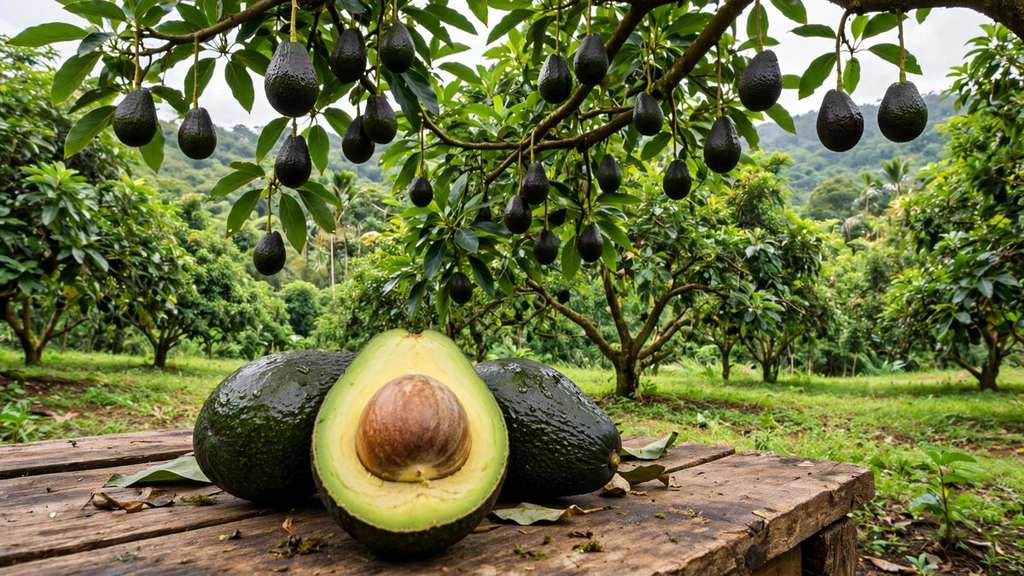
Cut an avocado open and the seed takes up a huge share of the fruit. That seed is too big for any wild animal in the Americas today to swallow whole, carry away and plant. Biologists have a name for a mismatch like that, and a leading explanation that reaches back to animals the size of small trucks.
A fruit waiting for a partner that vanished
In 1982, biologist Daniel Janzen and paleontologist Paul Martin published a hypothesis in the journal Science. Some fruits in the Americas, they argued, still carry traits shaped by giant mammals that are extinct. They called such traits ecological anachronisms. Author Connie Barlow later built her book The Ghosts of Evolution around the idea, with the avocado as a leading case. The fruit offers rich, fatty pulp around one large, hard seed. A small animal eats the pulp and drops the seed under the same tree. A giant animal could swallow the whole fruit, walk away, and deposit the seed in dung at a new site, clear of the parent tree and its shade.
The giants in the story
National Geographic lists the avocado eaters of that older world. They include Megatherium, a giant ground sloth that weighed about four tons and stood as tall as a giraffe. They include Toxodon, a heavy plant eater built a bit like a rhinoceros. They include Glyptodon, an armadillo relative the size of a small car, and the gomphotheres, elephant relatives with four tusks. The American Museum of Natural History describes another ground sloth, Lestodon, at about 15 feet long, eating avocados whole and depositing the pits in new places. A professor emeritus at the University of Oslo, Klaus Hoiland, told Science Norway that the avocado is one of the clearest footprints left by extinct megafauna, because its seed only makes sense with a very large eater.
The partner died out about 13,000 years ago
About 13,000 years ago, the large mammals of the Americas collapsed. National Geographic reports that South America lost about 83 percent of its large mammal species and North America lost about 68 percent. Every giant avocado eater on the list died in that wave. The avocado kept making the same large seeded fruit anyway. Evolution does not update a tree on a schedule. Barlow told Smithsonian Magazine that without a large disperser, avocado seeds would rot where they fell and any seedling would have to compete with its own parent tree for light.
People took the job, by hand
What saved the avocado, in this account, was appetite plus farming. People in Mexico were cultivating avocados by about 5,000 BCE, selecting and planting the fruit themselves. Farmers replaced the ground sloth as the seed carrier, moving seeds to cleared ground on purpose. The fruit on sale today still carries the old design brief: soft fatty pulp, tough skin, and one seed sized for a gut that no longer exists.
The honest caution belongs here too. The giant sloth account is a hypothesis, not a filmed event. No study has watched a ground sloth eat an avocado, because the animals have been gone for thousands of years. What the evidence shows is the fit: a seed too large for living dispersers, a family of extinct giants big enough to move it, and a fruit that survived only after people began planting it. Readers can hold the idea the way scientists do, as the best current explanation for a seed that looks oversized for its world.