
Vulcan Rocket Returns to Flight Sunday With 40 Amazon Satellites
After two scrubs in two days, United Launch Alliance tries again at 12:11 p.m. ET on Sunday to fly Vulcan for the first time since a booster anomaly grounded it in February.
Key points
- Updated November 15, 2026.
- ULA said it does not yet have specific data on what occurred.
- NASA Administrator Jared Isaacman offered NASA help with the investigation.
Update: Anomaly Ends the Mission
Updated November 15, 2026. United Launch Alliance confirmed that Vulcan suffered an anomaly 10 minutes into flight on Sunday and failed to deliver its 40 Amazon Leo satellites to orbit. The confirmation reverses the outcome of the liftoff reported earlier in this article. The satellites had been scheduled to begin deploying about 70 minutes into flight. They did not reach orbit.
ULA said it does not yet have specific data on what occurred. In its media update, the company said: "Every flight generates data, and every flight teaches us something. Since the anomaly just occurred, we don’t have any specific data yet to understand what occurred today," ULA added: "Today, we did not meet that standard." The company said it will work closely with its customer and other appropriate organizations to find the cause, determine the appropriate corrective action, and return to flight as quickly as possible.
NASA Administrator Jared Isaacman offered NASA help with the investigation. "Appreciate you quickly keeping the public and your partners informed. The team at @NASA is available to assist in all matters related to the investigation and remediation effort. Artemis, Moon Base, and the nation need ULA. We are in your corner and here to help," Isaacman said.
The flight was Vulcan's return to flight after the February 12, 2026 booster anomaly. It lifted off at 12:41 p.m. ET from Cape Canaveral Space Force Station, and all six solid rocket boosters jettisoned at one minute 45 seconds, at 22 miles.
Update: Liftoff at 12:41 p.m. ET
Updated November 15, 2026. Vulcan lifted off at 12:41 p.m. ET on Sunday from Cape Canaveral Space Force Station, after a late countdown hold in which the clock was rewound and a new 12:40 p.m. ET target was set at the end of the 29 minute window. At one minute 45 seconds into flight, at an altitude of 22 miles, United Launch Alliance reported all six solid rocket boosters jettisoned. The rocket is the VC6L configuration, with six solid boosters and a Leo optimized Centaur V upper stage, about 215 feet tall with a fueled weight of 1.99 million pounds. The 40 Amazon Leo satellites on board were scheduled to begin deploying about 70 minutes into flight, over about 25 minutes. ULA had not confirmed the deployments when this update was published, and this article will be updated again when it does. The flight is Vulcan's return to flight after the February 12, 2026 booster anomaly, and the first of 38 Vulcan launches Amazon has booked for Leo.
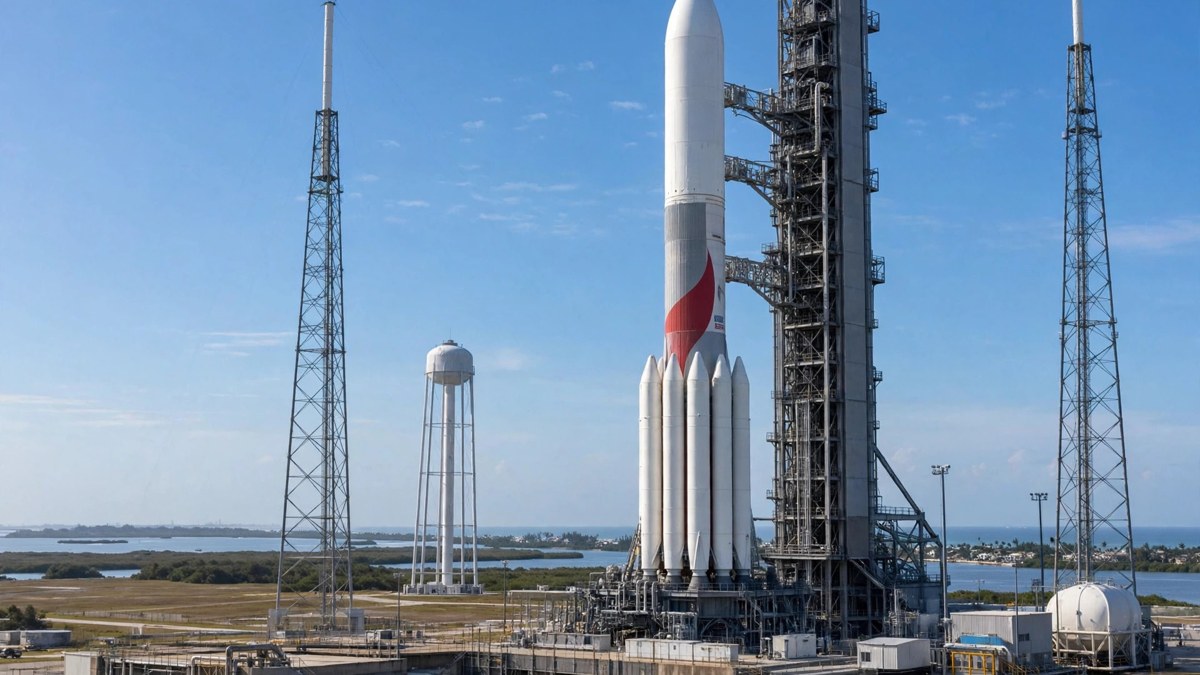
United Launch Alliance is set to fly its Vulcan rocket on Sunday, November 15, for the first time in nine months, carrying 40 satellites for Amazon's Leo broadband network from Cape Canaveral Space Force Station in Florida. Liftoff from Launch Complex 41 is scheduled for 12:11 p.m. ET, with a 29-minute window that runs to 12:40 p.m. Forecasters put the odds of acceptable weather at 95 percent.
The mission, named Amazon Leo 1, is a return to flight. Vulcan has not flown since February 12, 2026, when a booster anomaly shortly after liftoff on a Space Force mission grounded the rocket. A similar nozzle problem on one of its solid rocket boosters had already appeared during a flight in October 2024. The rocket flying on Sunday uses the most powerful Vulcan version, with six GEM-63XL solid boosters, an extended payload fairing and a Centaur V upper stage. It stands about 215 feet tall.
Two scrubs in two days
The launch was first set for Friday, November 13, and was scrubbed during fueling after a commodity flow issue with a supplier. A second attempt on Saturday, November 14, was called off after a network communication problem developed between ground equipment and the launch vehicle. ULA said the fix needed would have pushed the hold past the end of the launch window. The company said the rocket and the spacecraft remain healthy.
What is on board
The 40 satellites are the largest batch Amazon has put on a single Leo launch so far. They will be released in 21 separate deployment events into a circular orbit about 450 kilometres up, starting roughly one hour and seventeen minutes after liftoff. Once they are deployed, the Leo constellation will stand at 432 satellites. The flight is the first of up to 38 Vulcan launches Amazon has booked with ULA for the network, which is meant to compete with SpaceX's Starlink. Amazon previously flew eight Leo missions on ULA's older Atlas V rocket.
Why it matters
ULA needs a clean flight. Vulcan is the company's main rocket for both commercial customers and Space Force missions, and a second booster problem would extend the grounding and push national security launches further back. A good flight clears the way for a faster launch pace, with the next Amazon Leo mission already being prepared. The satellite deployment sequence ends about 25 minutes after it begins, and ULA will confirm the result once the last spacecraft separates.
Timeline
- Feb 12, 2026A booster anomaly shortly after liftoff grounds Vulcan after a Space Force mission.
- Nov 13, 2026First launch attempt for Amazon Leo 1 is scrubbed during fueling over a supplier commodity flow issue.
- Nov 14, 2026Second attempt is scrubbed after a network communication problem between ground equipment and the vehicle.
- Nov 15, 2026Third attempt set for 12:11 p.m. ET from Launch Complex 41, with a 29-minute window.
- Nov 15, 2026Vulcan lifts off at 12:41 p.m. ET. All six solid rocket boosters jettison cleanly at one minute 45 seconds, at an altitude of 22 miles.
- Nov 15, 2026ULA confirms an anomaly 10 minutes into flight. Vulcan fails to deliver the 40 Amazon Leo satellites to orbit, and ULA begins work to find the cause and return to flight.
Sources
- Florida Today: ULA Vulcan launch today from Cape Canaveral, everything to know
- NASASpaceFlight: ULA's Vulcan set to return to flight with first Amazon Leo payload
- Aviation Week: Vulcan return-to-flight launch reset for Nov. 15
- FOX 35 Orlando: ULA delays Vulcan rocket launch due to communication issue
- United Launch Alliance: Vulcan Leo 1 mission page