
Spain Approves One Housing Decree by One Vote a Day After First General Strike in 14 Years
Caretaker lawmakers in Madrid backed rent caps and a temporary ban on evictions by a single vote on Thursday, and rejected automatic renewal of rental contracts by the same margin, a day after millions of workers walked out over housing costs.
Key points
- Spanish lawmakers approved one of the government's two housing decrees by a single vote on Thursday, a day after the country held its first general strike in 14 years in protest at the cost of…
- The standing body of 69 caretaker deputies, who stay in place after parliament is dissolved, passed the decree by a one vote margin, Reuters reported.
- Both decrees took effect temporarily when published in the official gazette in early October.
Spanish lawmakers approved one of the government's two housing decrees by a single vote on Thursday, a day after the country held its first general strike in 14 years in protest at the cost of renting and buying a home.
The standing body of 69 caretaker deputies, who stay in place after parliament is dissolved, passed the decree by a one vote margin, Reuters reported. The decree keeps rent caps in force, along with a temporary ban on evictions and limits on corporate purchases of residential property. The same body rejected, also by one vote, a second measure backed by tenants' associations that would have made renewal of rental contracts automatic.
Both decrees took effect temporarily when published in the official gazette in early October. Parliament rejected them last month, and Prime Minister Pedro Sanchez responded by calling a snap election, now set for November 29. Opposition leader Alberto Nunez Feijoo, whose People's Party leads in polls, said on Wednesday he would repeal the decrees if he becomes prime minister. The opposition argues the measures cut housing supply and push prices up.
A strike built on rent
The vote came a day after Wednesday's general strike, the first in Spain since the 2012 austerity strike. It was backed by the two largest unions, UGT and CCOO, and by tenants' associations. Unions said about 4 million workers took part, around one fifth of the workforce in a country of about 23 million workers, Reuters reported. The strike ran under the slogan "Salaries. Housing. Prices.", and the unions also want a new minimum wage agreement, the Associated Press reported.
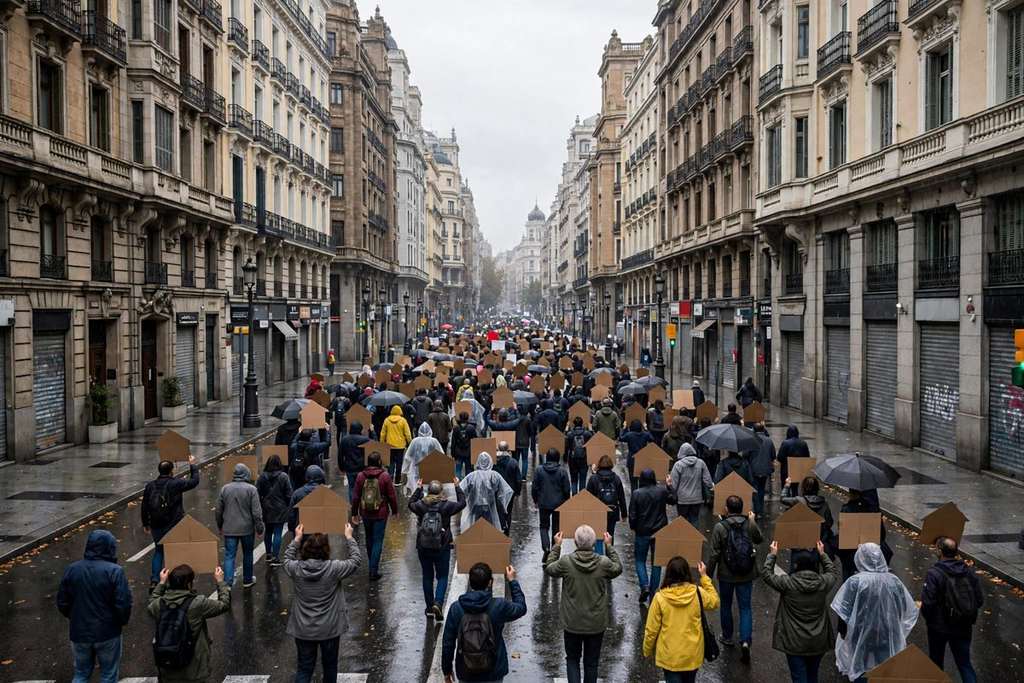
Marchers filled streets in Madrid, Barcelona and other cities in stormy weather. Officials estimated about 120,000 people marched in Madrid. Authorities in Barcelona put the crowd there at about 55,000, while organizers claimed 400,000. On Madrid's Gran Via, protesters cheered as large stores pulled down their shutters, holding house keys and placards shaped like houses.
Spain has a shortage of about 750,000 homes, set to pass one million by 2028, according to the central bank. The average rent of 1,176 euros, about 1,315 dollars, equals about 98.7 percent of a young person's average monthly salary, according to the Youth Council of Spain. Average rent has almost doubled in ten years, the Associated Press reported.
"I am 36 years old and I still cannot move out on my own," Jesus Gonzalez, who works in a hospital IT department in Madrid and backed the strike, told Reuters. "Rents just keep going up, house prices just keep going up, and it is simply impossible."
Clashes at the end of the day
The strike was mostly peaceful, but clashes broke out in the evening in Barcelona and Madrid. Police reported at least 73 arrests nationwide by 9 p.m. GMT from at least 1,044 incidents linked to the strike, Reuters reported. In Madrid, riot police used foam bullets, tear gas and pepper spray near Plaza de Espana. Unions said they would file a criminal complaint over a police response they called disproportionate and said injured 20 protesters. The Interior Ministry did not immediately respond to a request for comment.
Protests grew after the eviction on September 23 of Maricarmen Abascal, an 87 year old woman removed from the Madrid flat where she had lived for seven decades. She later died in hospital. Sanchez hopes voter anger over housing will help his Socialist Party on November 29, though it still trails in polls. Business groups disagreed. Angela de Miguel of the CEOE business lobby called the strike counterproductive and said the answer was to build more homes.
Timeline
- Sep 23, 2026Maricarmen Abascal, 87, is evicted from the Madrid flat where she had lived for seven decades. Protests over housing grow across Spain, and she later dies in hospital.
- Nov 11, 2026Spain holds its first general strike since 2012, as unions and tenants' associations protest over housing costs, wages and prices.
- Nov 12, 2026Caretaker lawmakers approve one housing decree by one vote, keeping rent caps and a temporary eviction ban, and reject automatic renewal of rental contracts by one vote.
- Nov 29, 2026Spain votes in the snap general election called by Prime Minister Pedro Sanchez.
Sources
- Reuters: Spain approves one of housing decrees that triggered snap election
- Reuters via Devdiscourse: Millions of Spaniards stage first general strike in 14 years as anger over housing leads to clashes
- Associated Press via NPR and WHRO: Spain's workers hold a general strike over housing costs before national election