
Semeru Erupts Six Times, Pyroclastic Flows Reach 4.5 km
Mount Semeru in East Java erupted six times on Thursday, sending ash 700 metres above the summit and hot flows down the Besuk Kobokan valley. The alert stays at Level III.
Key points
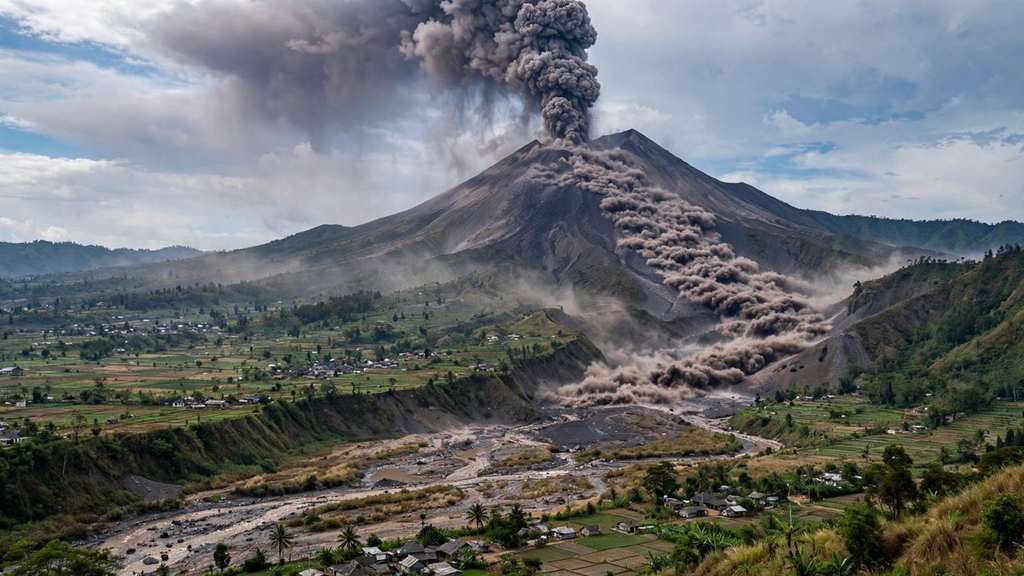
- Mount Semeru, the highest volcano on Java, erupted six times on Thursday, November 5, sending ash hundreds of metres into the sky and pyroclastic flows down its southeast slope.
- The eruptions began in the early hours.
- Muhammad Amrul, head of the operations control centre at the East Java Disaster Management Agency, reported three pyroclastic flows by noon local time.
Mount Semeru, the highest volcano on Java, erupted six times on Thursday, November 5, sending ash hundreds of metres into the sky and pyroclastic flows down its southeast slope. Sand miners working the river valleys below the summit fled as the flows moved through the Besuk Kobokan drainage, according to East Java disaster officials. No casualties had been reported by midday.
The eruptions began in the early hours. Eruptions were recorded at 3:33 a.m. and 5:37 a.m. local time, and the strongest, at 6:33 a.m., threw an ash column about 700 metres above the summit, reaching about 4,376 metres above sea level. A later eruption at 9:24 a.m. also produced a column of about 700 metres, with a seismograph amplitude of 31 millimetres and a duration of seven minutes and 27 seconds.
Flows down Besuk Kobokan
Muhammad Amrul, head of the operations control centre at the East Java Disaster Management Agency, reported three pyroclastic flows by noon local time. The flows travelled between 3,000 and 4,500 metres from the summit toward the southeast, into the Besuk Kobokan sector. A pyroclastic flow is a fast current of hot gas, ash and rock. It is the deadliest part of an eruption like this one, and it follows river valleys, which is why the valleys below Semeru are watched first.
Semeru stands 3,676 metres high on the border of Lumajang and Malang regencies in East Java. It is one of the most active volcanoes in Indonesia and erupts often. The alert level remains at Level III, called Siaga, the second highest on Indonesia's four step scale. Authorities told people to stay outside a five kilometre radius from the crater and away from the southeastern danger zone and the river valleys exposed to flows and lahars.
A week that started with a lahar
Thursday's eruptions came three days after a lahar, a cold flood of volcanic mud, tore through the same valleys. Heavy rain on November 1 and 2 sent mud down the Glidik River in Lumajang. The flow broke through about 200 metres of a levee under repair, damaged river control works, destroyed three houses and cut off Taman Sari Hamlet, leaving 117 families isolated. No lives were lost in that flood, officials said at the time.
The two events are linked by the mountain itself. An eruption drops fresh ash and rock on the slopes. Rain then washes that loose material down the valleys as a lahar, with no new eruption needed. That is why officials warn about rivers even on quiet days, and why Thursday's fresh deposits raise the lahar risk the next time heavy rain falls on the summit area.
Key numbers
- 6: eruptions recorded on Thursday, November 5
- 700 metres: height of the largest ash columns above the summit
- 3,000 to 4,500 metres: distance travelled by the pyroclastic flows
- Level III (Siaga): the current alert level
- 5 kilometres: the crater exclusion radius set by authorities
- 117: families cut off by the November 2 lahar in Taman Sari Hamlet
What happens next
Monitoring posts will watch the summit through the night. The practical risks for villages in Lumajang are ash fall, further flows down Besuk Kobokan, and lahars if rain follows. Residents near the valleys have been told to move away from riverbanks when sirens or official warnings sound, and to follow the volcanology agency and local disaster officials rather than social media clips, which on past Semeru days have mixed old footage with new events.
Timeline
- Nov 2, 2026A lahar breaks a Glidik River levee in Lumajang, destroys three houses and isolates 117 families in Taman Sari Hamlet.
- Nov 5, 2026Semeru erupts six times; the strongest eruption at 6:33 a.m. sends ash 700 metres above the summit and flows reach 4,500 metres.