
Kospi Slides 4.8 Percent and Triggers a Sidecar as Chip Stocks Fall in Seoul
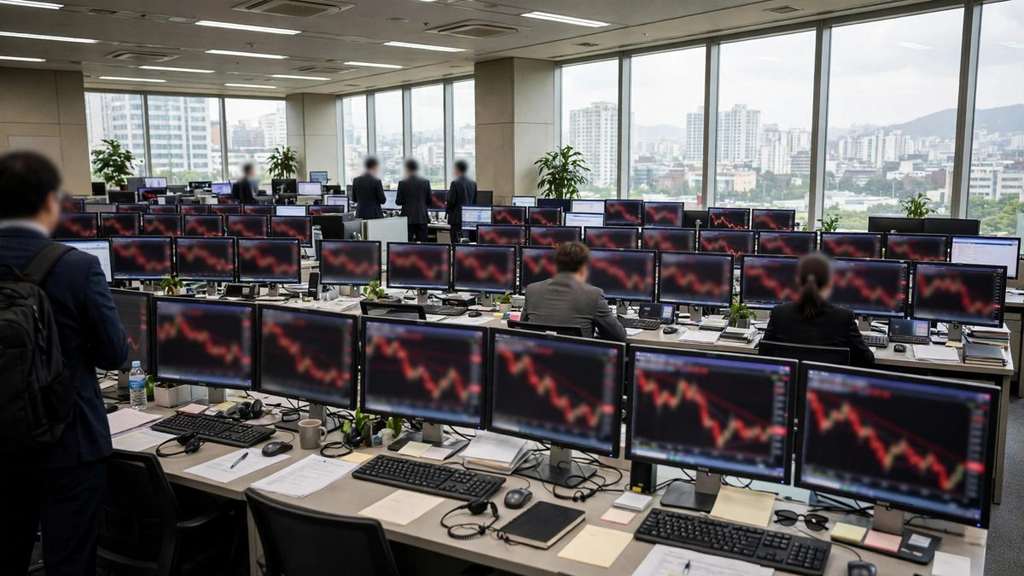
South Korea's Kospi fell about 4.8 percent on Thursday and the Kosdaq fell 4.3 percent as AI and chip shares slid in Seoul and Tokyo, while Shanghai and Hong Kong rose sharply the other way.
Key points
- Updated 08:53 UTC
- Seoul has closed, and the final numbers are worse than the morning slide.
- Foreign investors sold a net 3.39 trillion won, about 2.3 billion dollars, of shares on the main board.
Updated 08:53 UTC
Seoul has closed, and the final numbers are worse than the morning slide. The Kospi ended at 5,383.80, down 300.00 points, or 5.28 percent, according to Korea Exchange figures reported by the Seoul Economic Daily. It was the first close below 5,400 in about seven months, since 5,377.30 on April 3. The Kosdaq ended at 678.41, down 36.54 points, or 5.11 percent, its first close below 700 since July 30.
Foreign investors sold a net 3.39 trillion won, about 2.3 billion dollars, of shares on the main board. Individuals bought a net 2.27 trillion won and institutions bought a net 845.7 billion won, and that buying was not enough to absorb the selling. Sidecar curbs were triggered in both markets for the first time in 15 trading sessions, since October 15.
Samsung Electronics closed at 201,500 won, down 7.57 percent. The stock fell as low as 199,800 won during the session, below 200,000 won for the first time since July 29. The Edge, citing exchange closing values, put Taiwan's Taiex down 3.20 percent at 41,574.72 at the close and Japan's Nikkei 225 down 1.79 percent at 61,077.90.
South Korea's Kospi slumped about 4.8 percent on Thursday, November 5, 2026, and the Kosdaq fell about 4.3 percent, as artificial intelligence and chip stocks extended their slide across Asia.
The selling was sharp enough to trigger a sidecar on the Korean exchange. A sidecar is a five minute pause in program trading tied to sharp moves in Kospi 200 futures, and Informist reported that a sell side sidecar was triggered after the Kospi 200 Futures Index fell 5 percent. Informist said the Kospi fell as much as 5 percent in early Thursday trade.
At 0750 IST the Kospi stood at 5,454.36, down 4.0 percent. In Seoul, SK Hynix fell more than 6 percent and Samsung Electronics fell nearly 5 percent. Reuters reported that the Kospi slid 4 percent in morning trade and was not far from a seven month low.
Chip stocks lead the fall in Tokyo too
Japan split. The Nikkei fell about 1.5 percent as chip equipment makers slumped, while the broader Topix rose about 1.4 percent, led by real estate, retail and pharmaceutical shares. Informist put Advantest down nearly 9 percent, Lasertec down more than 10 percent, Tokyo Electron down 7 percent and Renesas down 4 percent.
SoftBank Group fell about 5.8 percent to around 4,020 yen, hit by a slide in Arm shares and the wider AI selloff. Reuters put Taiwan's benchmark down 1.8 percent on the day.
Reuters said data centre companies and their equipment suppliers across Asia fell on expectations of tougher regulation after Democrats won the United States midterm elections, while solar supply chain stocks jumped the most. "The magnitude of the victory is what has caught markets off guard," Chris Weston, head of research at Pepperstone in Melbourne, told Reuters about the midterm result.
China and Hong Kong move the other way
Chinese markets rose sharply while Seoul and Tokyo chip names fell. The Shanghai Composite jumped about 3.6 percent and Hong Kong's Hang Seng rose about 3 percent. Informist put the Hang Seng at 24,632.32, up 3.0 percent at 0750 IST, with Tencent up over 6 percent, Xiaomi up nearly 8 percent and Alibaba up nearly 7 percent.
The split left Asia with two clear camps on Thursday morning. Markets tied closely to AI hardware and chip equipment took the losses, and markets driven by Chinese internet names and Japanese domestic shares gained.
Oil stays lower and gold extends its rally
Oil stayed lower through the Asia morning. Reuters put Brent at 93.50 dollars a barrel, testing overnight lows, after Brent dived nearly 9 percent overnight and fell below 100 dollars. Gold extended its rally to around 4,135 dollars an ounce, building on a jump of about 3 percent on Wednesday.
The Korean exchange also said trading will open an hour late on November 19 to keep roads clear for the national university entrance exam.
Timeline
- Nov 5, 2026The Kospi stands at 5,454.36, down 4.0 percent at 0750 IST, and a sell side sidecar is triggered after Kospi 200 futures fall 5 percent.
- Nov 5, 2026The Kospi slide reaches about 4.8 percent and the Kosdaq falls 4.3 percent, while the Shanghai Composite rises 3.6 percent and the Hang Seng rises 3.0 percent.
- Nov 5, 2026Seoul closes: the Kospi ends at 5,383.80, down 5.28 percent, its first close below 5,400 since April 3, and the Kosdaq ends at 678.41, down 5.11 percent, its first close below 700 since July 30.
- Nov 19, 2026Trading on the Korean exchange opens an hour late to keep roads clear for the national university entrance exam.
Sources
- Reuters: Global markets report, November 5, 2026
- Informist: Equity Alert, GIFT Nifty signals gap up open for Nifty 50 as oil prices fall
- investingLive: Asia-Pacific market news wrap
- Seoul Economic Daily: Blue Wave triggers Black Thursday as Kospi falls to April lows
- The Edge: Asia Market Wrap, November 5, 2026