
Federal Report Finds Chain of Failures in Colorado Fire That Killed Four Firefighters
Investigators say extreme fire behavior, strained communications, gaps in air supervision and staffing shortages combined on June 27 in Mesa County. No single failure explains the deaths.
Key points
- A federal investigation into the deaths of four wildland firefighters in western Colorado found no single failure behind the tragedy.
- The Department of the Interior released the Knowles Fire Serious Accident Investigation Report on Thursday.
- Emily Barker, Sydney Watson and Nick Hutcherson died on June 27.
A federal investigation into the deaths of four wildland firefighters in western Colorado found no single failure behind the tragedy. It found a chain of them.
The Department of the Interior released the Knowles Fire Serious Accident Investigation Report on Thursday. The report, from a joint investigation by the U.S. Wildland Fire Service and the U.S. Forest Service, examined the June 27 burnover in Mesa County that killed three members of a helitack crew that day and a fourth who died of his injuries weeks later.
The four firefighters
Emily Barker, Sydney Watson and Nick Hutcherson died on June 27. Nathan Matthews died on July 24 after being hospitalized. A fifth crew member was injured and hospitalized that day, the Interior Department said.
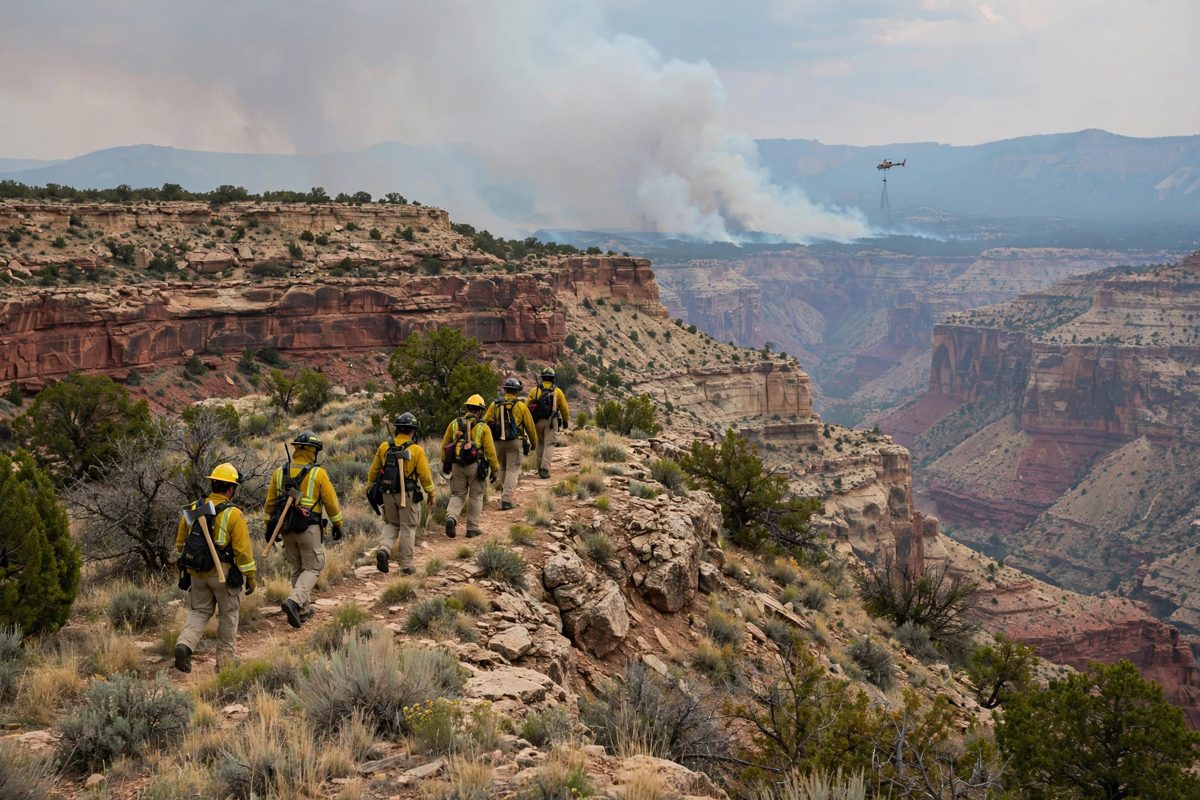
The Rifle Helitack crew was doing initial attack work on two smaller fires, the Knowles and Gore fires, in rugged mesa and canyon country when a larger fire, the Snyder Fire, overtook them, Colorado Public Radio reported.
Seven and a half miles in under three hours
From about 12:36 p.m. until 3:19 p.m., the fire ran just under seven and a half miles over broken mesa and canyon topography, a pace interviewees called shocking and unfathomable, according to Colorado Public Radio.
At 3:19 p.m., Barker ordered the team to pull their emergency fire shelters. Temperatures around the shelters later reached as high as 1,200 degrees. Two and a half hours passed before a helicopter could land. The surviving firefighter and Matthews were airlifted out. The other three were dead.
The air and radio gaps
From 2:30 p.m. to 4:30 p.m., the area where the firefighters died was without air attack coverage, and the crew did not know it, the report says. One air team had returned to Grand Junction to refuel, and the relief team could not take off because of high crosswinds. The crew and the pilot tending to them worked under the false belief that air attack was watching the main fire and would warn them, the report says.
A radio problem sent updates meant to tell air support where the ground crew was to an air team fighting another fire 30 miles away. Pilots told investigators the flying conditions were the roughest of their careers.
What investigators concluded
The Interior Department summarized the cause as a cumulative interaction of factors: extraordinary fire behavior, strained communications, incomplete situational awareness, jurisdictional complexity, gaps in aerial supervision and extreme operational tempo. The report itself puts it plainly, in a passage quoted by Colorado Public Radio: "No single decision or system failure fully explains the outcome."
A second Colorado Public Radio account counted more than 20 issues in the findings. Dispatch centers were largely staffed with trainees and left understaffed by vacancies. Aging radio infrastructure hampered communications. Helitack crews were stretched thin by vacant posts. Because the fires crossed state lines, dispatchers had to log in and out of separate systems, which added delays.
The fixes the report recommends
The recommendations include filling vacant posts at once, among them a telecommunications specialist, funding a vacant assistant foreman position, setting minimum helitack staffing, giving helitack members handheld tracking devices, and combining several fires into one incident sooner. They also call for consolidating dispatch across jurisdictions, dedicating ground lookouts who do not depend on air operations, and building extra evacuation time into trigger point guidance.
Secretary of the Interior Doug Burgum said firefighter safety will always be the department's highest priority. Colorado Public Radio reported that it is not yet clear what steps, if any, have been taken to act on the findings.
Timeline
- Jun 27, 2026The Snyder Fire overtakes a Rifle Helitack crew working the Knowles and Gore fires in Mesa County. Emily Barker, Sydney Watson and Nick Hutcherson die, and Nathan Matthews and a fifth firefighter are injured.
- Jul 24, 2026Nathan Matthews dies of his injuries, the fourth firefighter killed in the incident.
- Nov 12, 2026The Department of the Interior releases the Knowles Fire Serious Accident Investigation Report, with findings and recommendations.
Sources
- U.S. Department of the Interior: Interior Releases Findings of Investigation into Firefighter Fatalities and Injury on the Knowles Fire
- Colorado Public Radio: Dangerous weather, communication difficulties highlight deadly wildfire
- Colorado Public Radio: Fill vacancies, upgrade comms and more recommended in entrapment report for wildfire that killed 4 firefighters
- Fire Engineering: Deaths of Four Firefighters in CO Wildfire Caused by Extreme Fire Behavior, Human Error, Report Finds