
Modi Calls for Stronger Global Institutions at NDTV Summit
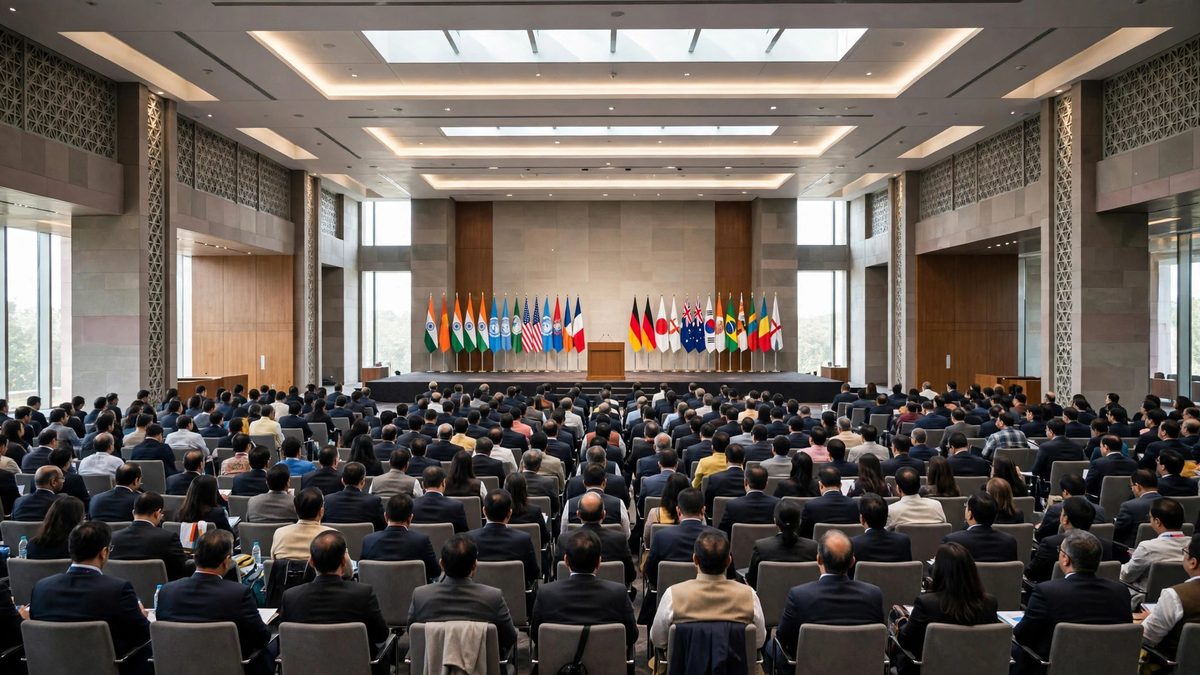
Prime Minister Narendra Modi told the NDTV World Summit in New Delhi on Thursday that world bodies are struggling to keep pace with change. He called for a greater voice for the Global South and cooperation that holds in a crisis.
Key points
- Prime Minister Narendra Modi called on Thursday for stronger global institutions and a greater voice for the Global South, telling a summit in New Delhi that bodies such as the United Nations are…
- Modi delivered the keynote address at the NDTV World Summit 2026, held in New Delhi on October 22 and 23 under the theme A World Between Orders.
- He used an old Sanskrit idea to make the point.
Prime Minister Narendra Modi called on Thursday for stronger global institutions and a greater voice for the Global South, telling a summit in New Delhi that bodies such as the United Nations are struggling to keep pace with a changing world order.
Modi delivered the keynote address at the NDTV World Summit 2026, held in New Delhi on October 22 and 23 under the theme A World Between Orders. He said trade, technology and sea routes were increasingly being used as weapons, and that a global system has to stop the strong from exploiting the vulnerable.
He used an old Sanskrit idea to make the point. He cited the statesman Chanakya and the phrase he translated as the law where big fish eat small fish when there is no order. The world does not need such a situation, Modi said. It needs a system that stops this from happening, using the Sanskrit term matsya nyaya for that state of lawlessness.
India as the example he offered
Modi presented India as an example of a country that helps hold such a system together. During the Covid-19 pandemic, he said, India sent vaccines to every country in need and sent medicines to more than 100 countries, at a time when many richer nations looked after themselves first.
In a second account of the same speech, carried by the IANS wire, Modi pointed to India's leadership of the G20 and BRICS summits, where consensus declarations were adopted despite doubts beforehand and despite member nations holding conflicting interests. He described India as a bridge builder, guided by the principle he gave in Hindi as development for all, with all, and called the country a Vishwa Bandhu, a friend to the world.
He tied the foreign policy argument to his domestic programme. The vision of Viksit Bharat, a developed India by 2047, is not only for the country's own progress, he said. It is also a guarantee for a better world. A stronger India, in his telling, strengthens global supply chains and adds confidence in innovation and productivity.
Who else is at the summit
The two day summit brings together ministers, diplomats and business and technology figures. The listed speakers include External Affairs Minister S. Jaishankar, former CIA director General David Petraeus, and Member of Parliament Shashi Tharoor, who chairs the Parliamentary Standing Committee on External Affairs.
From abroad, the line-up includes Abdulla bin Touq Al Marri, the UAE Minister of Economy and Tourism, Dr Swarnim Wagle, Nepal's Federal Minister of Finance, and Chaturanga Abeysinghe, Sri Lanka's Deputy Minister of Industry and Entrepreneurship Development. Diplomats from Germany, the European Union and Australia are also listed, along with Andrew Ng, the founder of DeepLearning.AI, and policy figures from Microsoft.
Sessions cover geopolitics, diplomacy, technology, business, science and culture, and the role of artificial intelligence runs through several of them.
Why it matters and what happens next
The speech is a pitch for how India wants to be seen while the rules of trade and security are being rewritten. Modi did not name a country as the source of the weaponised trade and sea routes he described. The argument lands the same way. India is asking for a larger seat in the institutions that set the rules, and offering its pandemic record, its summit chairmanships and its growth as the evidence.
The summit continues on Friday, October 23, with Jaishankar and other ministers speaking on India's choices. What to watch is whether any of the visiting ministers answer the Global South argument in public, or whether the call stays an Indian position stated at an Indian summit.
Timeline
- Oct 22, 2026Modi delivered the keynote address at the NDTV World Summit in New Delhi, calling for stronger global institutions and a greater voice for the Global South.
- Oct 23, 2026The summit continues for a second day in New Delhi, with External Affairs Minister S. Jaishankar among the listed speakers.